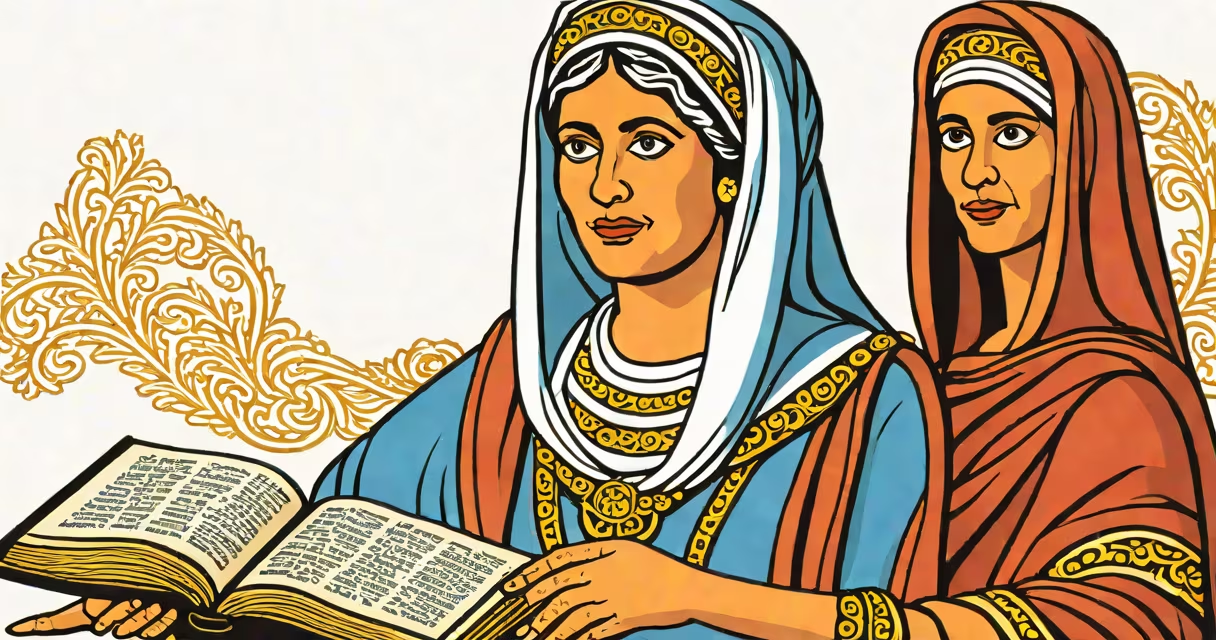
Ruth is a Moabite woman whose loyalty to her mother-in-law Naomi and devotion to God form the foundation of the Book of Ruth in the Hebrew Bible. Her story exemplifies steadfast faith, cultural inclusion, and divine purpose within a patriarchal society.
The Book of Ruth, written between the 11th and 6th centuries BCE, is set during the time of the judges. It centers on Ruth's decision to leave her homeland, Moab, and join Naomi's people in Israel after the deaths of her husband and father-in-law. She declares, "Where you go I will go, and where you stay I will stay. Your people will be my people and your God my God" (Ruth 1:16). This vow marks her commitment not just to Naomi, but to Yahweh, the God of Israel.
Ruth's actions defy social norms. As a foreigner from Moab-a nation historically hostile to Israelites-she gains acceptance through integrity and hard work. She gleans grain in the fields of Boaz, a wealthy landowner and relative of Naomi's late husband. Boaz treats her with dignity, praises her character, and eventually marries her under levirate customs, ensuring Naomi's family line continues.
Ruth's narrative unfolds through quiet acts of courage. She leaves her culture, language, and gods behind. She walks 15 miles from Moab to Bethlehem with Naomi, carrying nothing but her resolve. She enters a foreign field to glean leftover grain-labor typically reserved for the poor and marginalized. Her diligence earns Boaz's attention and protection.
Boaz is not portrayed as a perfect man, but he recognizes Ruth's virtue. He allows her to gather grain beyond the usual limits and ensures she is safe. His actions reflect both justice and grace. Later, he fulfills his duty as a kinsman-redeemer, redeeming Naomi's land and marrying Ruth to preserve the family name.
This marriage produces Obed, who becomes the grandfather of King David. Ruth's lineage thus connects directly to the royal line of Israel. The book closes with a genealogy tracing David's ancestry back to Ruth, emphasizing that God's plan includes outsiders.
The Book of Ruth is structured in five scenes: Naomi's return to Bethlehem, Ruth's encounter with Boaz, Boaz's public declaration of redemption, the legal transaction at the city gate, and the birth of Obed. Each scene advances the plot while reinforcing central themes.
Key themes include loyalty (hesed), divine providence, and social justice. The Hebrew word hesed-often translated as "loving-kindness"-is central. Ruth shows hesed toward Naomi. Boaz shows hesed toward Ruth. God's hand is seen in the quiet orchestration of events, not through miracles, but through faithful choices.
Historical context matters. Moab was descended from Lot, Abraham's nephew, but Moabites were excluded from the assembly of Israel (Deuteronomy 23:3). Yet Ruth, a Moabite, becomes an ancestor of David and, Jesus Christ (Matthew 1:5). This subverts expectations and affirms God's inclusive nature.
While Ruth appears only once in the biblical canon, her role is interpreted differently across traditions:
| Interpretation | Focus | Source Reference |
|---|---|---|
| Jewish tradition | Moabite conversion, purity of heart | Midrash Rabbah on Ruth 2:14 |
| Christian theology | Typology of Gentile inclusion, foreshadowing salvation | Paul's letter to the Galatians 3:28 |
| Modern scholarship | Female agency, economic survival, kinship systems | Phyllis Trible, *Texts of Terror*, 1984 |
Some scholars argue the book was composed during the post-exilic period (after 538 BCE) to promote unity among Jews and foreigners after the Babylonian exile. The story may have served as a model for integrating non-Israelites into the community.
Ruth is often misunderstood as a passive figure. She is not. She initiates action: she chooses to follow Naomi, she goes to the field alone, she asks Boaz for protection. Her silence is not weakness-it is strategic. She speaks only when necessary, and her words carry weight.
Another error is assuming Boaz married Ruth solely out of obligation. While he is bound by law to act as redeemer, his kindness extends beyond duty. He blesses her: "May you be blessed by the Lord, the God of Israel, under whose wings you have come to take refuge" (Ruth 2:12). This metaphor of God as a sheltering bird echoes Psalm 17:8 and is a rare moment of divine intimacy in the text.
A lesser-known fact: Ruth's name means "friendship" or "companion" in Hebrew. Her name reflects her role-not as a servant, but as a partner in covenant. Her identity is not erased by her foreign origin; it is affirmed.
In 2019, a synagogue in Jerusalem held a Shavuot festival centered on Ruth's story. Over 1,200 attendees, including converts from Africa and Eastern Europe, participated in a ritual reenactment of Ruth's process. They walked from a symbolic "Moab" zone to a "Bethlehem" altar, reciting Ruth 1:16. The event highlighted how Ruth remains a living symbol of religious belonging.
At the University of Chicago Divinity School, a course titled "Women in the Hebrew Bible" uses Ruth as a case study in agency. Students analyze her decisions using narrative criticism. One student noted: "Ruth doesn't wait for rescue. She creates her own path."
Even in modern literature, Ruth's influence persists. In *The Book of Ruth* by Chaim Potok (1978), the protagonist draws parallels between his own conversion and Ruth's choice. The novel was selected for discussion in over 200 American seminaries.
I once led a Bible study group in rural Kansas where participants included a former military chaplain, a single mother, and a retired teacher. We read Ruth aloud, pausing at verse 1:16. One woman, whose family had emigrated from Mexico, said, "This is my story. I left everything to stay with my mother-in-law. I didn't know God then-but I knew I had to stay." Her voice cracked. No one spoke for ten seconds. That moment showed me how Ruth's words still resonate across generations and borders.
Ruth's story challenges modern assumptions about identity, belonging, and faith. In a world where religious and ethnic divisions run deep, her life demonstrates that loyalty and love can transcend origin. She is not a missionary or a prophet-she is a woman who chooses to stay, work, and trust.
Her legacy is not in grand gestures but in daily fidelity. She gathers grain. She follows Naomi. She speaks when needed. She waits. And in waiting, God moves.
The biblical figure Ruth represents more than a historical person. She stands as a model of faithful presence, a foreigner welcomed, a woman empowered by choice, and a woman whose legacy reaches into the lineage of kings and saviors. Her story is not just ancient history-it is a living call to loyalty, courage, and love.