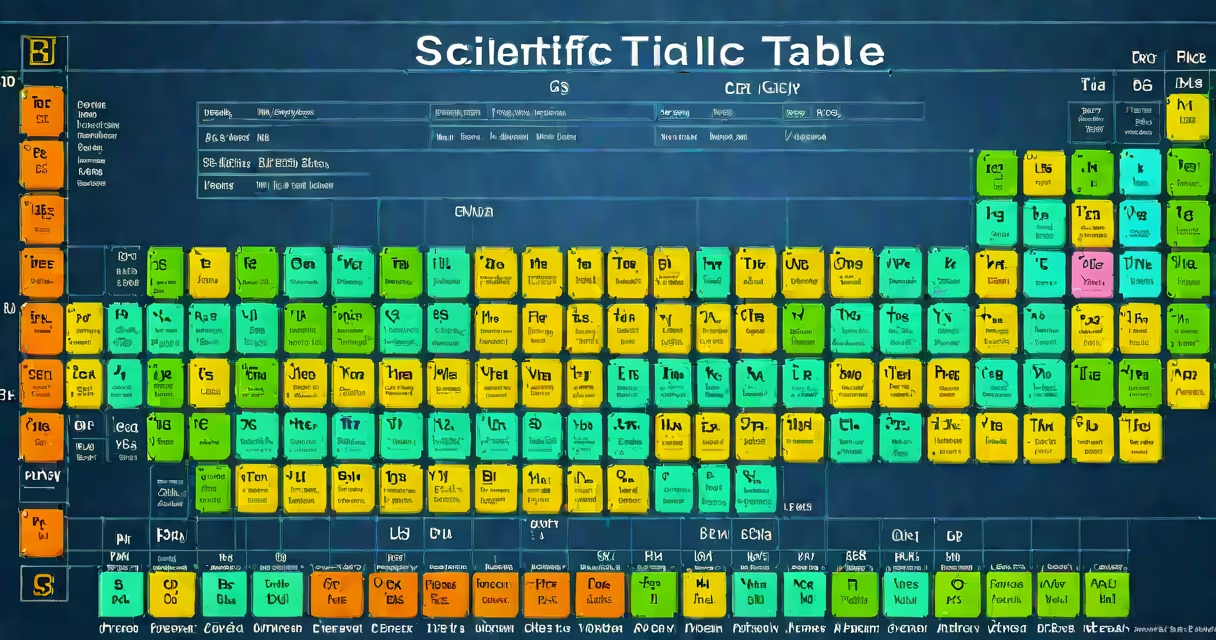
The scientific table, commonly known as the periodic table of elements, is a structured arrangement of all known chemical elements ordered by increasing atomic number, electron configuration, and recurring chemical properties. It displays 118 confirmed elements, grouped into rows (periods) and columns (groups), revealing periodic trends in reactivity, electronegativity, and atomic radius.
Elements are organized so that those with similar chemical behaviors appear in vertical columns. For example, Group 1 contains alkali metals like lithium and sodium, which all react vigorously with water. This layout allows scientists to predict how an element will behave based on its position. The table's design reflects decades of experimental data and theoretical insight, forming the foundation of modern chemistry.
Each box contains the element's symbol, atomic number (number of protons), and average atomic mass. The structure evolved from early attempts by Dmitri Mendeleev in 1869, who left gaps for undiscovered elements and accurately predicted their properties. Today, the table is maintained by the International Union of Pure and Applied Chemistry (IUPAC), which approves new element names and symbols.
The scientific table arranges elements by atomic number-the count of protons in an atom's nucleus. As atomic number increases, electrons fill energy levels and orbitals in a predictable pattern. This electron configuration determines how atoms bond and interact.
Rows (periods) represent the number of electron shells. Period 1 has two elements (hydrogen and helium), filling the first shell. Period 2 includes elements from lithium to neon, filling the second shell. Columns (groups) group elements with the same number of valence electrons-electrons in the outermost shell. Elements in Group 17, the halogens, have seven valence electrons and tend to gain one electron to form stable compounds.
Elements are divided into categories: metals (left side), metalloids (along the staircase line), and nonmetals (right side). Metals conduct heat and electricity, while nonmetals do not. Metalloids exhibit mixed properties-silicon, for example, is a semiconductor used in computer chips.
The scientific table is divided into blocks based on electron subshell filling:
| Block | Electron Subshell | Elements | Examples |
|---|---|---|---|
| s-block | ns² | Groups 1-2, and helium | Lithium (Li), calcium (Ca) |
| p-block | np⁶ | Groups 13-18 | Oxygen (O), chlorine (Cl), argon (Ar) |
| d-block | (n−1)d¹⁰ | Groups 3-12 | Iron (Fe), copper (Cu), zinc (Zn) |
| f-block | (n−2)f¹⁴ | Lanthanides and actinides | Cerium (Ce), uranium (U) |
These blocks reflect how electrons occupy orbitals. The f-block elements, including the rare earth metals, are often placed below the main table due to space constraints but are integral to the structure. Their electron configurations explain unique magnetic and optical properties used in lasers and MRI contrast agents.
Many assume the scientific table is static or complete. In reality, it is updated as new elements are synthesized. Elements beyond uranium (atomic number 92) are man-made and highly unstable. Nihonium (element 113), for example, was created in 2003 and confirmed by IUPAC in 2015. Its half-life is less than a second, yet its placement in Group 13 validates the predictive power of the table.
Another misconception is that the table shows physical states. While some visualizations include state icons (solid, liquid, gas), the standard table does not. A common error is assuming all elements in a group behave identically. Fluorine and iodine are both halogens, but fluorine is far more reactive due to smaller atomic size and higher electronegativity.
A lesser-known fact: the scientific table's spacing reflects atomic radii. As you move left to right across a period, atomic radius decreases due to increased nuclear charge pulling electrons closer. Moving down a group, radius increases because of additional electron shells. This trend explains why cesium (Group 1, Period 6) reacts explosively with water-its outer electron is far from the nucleus and easily lost.
The scientific table guides material selection in engineering and medicine. Titanium (Ti, atomic number 22) is used in orthopedic implants because it resists corrosion and bonds well with bone tissue. Its position in Group 4 indicates high strength-to-weight ratio and resistance to oxidation-properties derived from its electron configuration.
In drug development, understanding element behavior is critical. Carbon (C), nitrogen (N), oxygen (O), and hydrogen (H) make up most organic molecules. Adding halogens like fluorine improves metabolic stability in pharmaceuticals. Fluoxetine (Prozac), for example, contains a fluorinated benzene ring that slows breakdown in the body, extending its therapeutic effect.
A worked example: consider gallium (Ga, atomic number 31). Located in Group 13, Period 4, gallium has three valence electrons. It melts at 29.8°C-just above room temperature-making it useful in thermometers and semiconductors. Its low melting point results from weak metallic bonding due to poor overlap of s and p orbitals. This property, predicted by its position, led to its use in high-frequency electronics.
When designing experiments, researchers rely on the scientific table to anticipate outcomes. For instance, placing aluminum (Al) in a solution of copper sulfate triggers a displacement reaction. Aluminum is more reactive than copper, as shown by their positions in the activity series-a concept derived from the table. The reaction produces aluminum sulfate and metallic copper, visible as a reddish deposit.
The scientific table is not just a chart-it is a living structure for understanding matter. Its predictive power continues to improve in materials science, environmental chemistry, and biomedical engineering. By decoding its structure, anyone can grasp the hidden logic behind the building blocks of the universe.