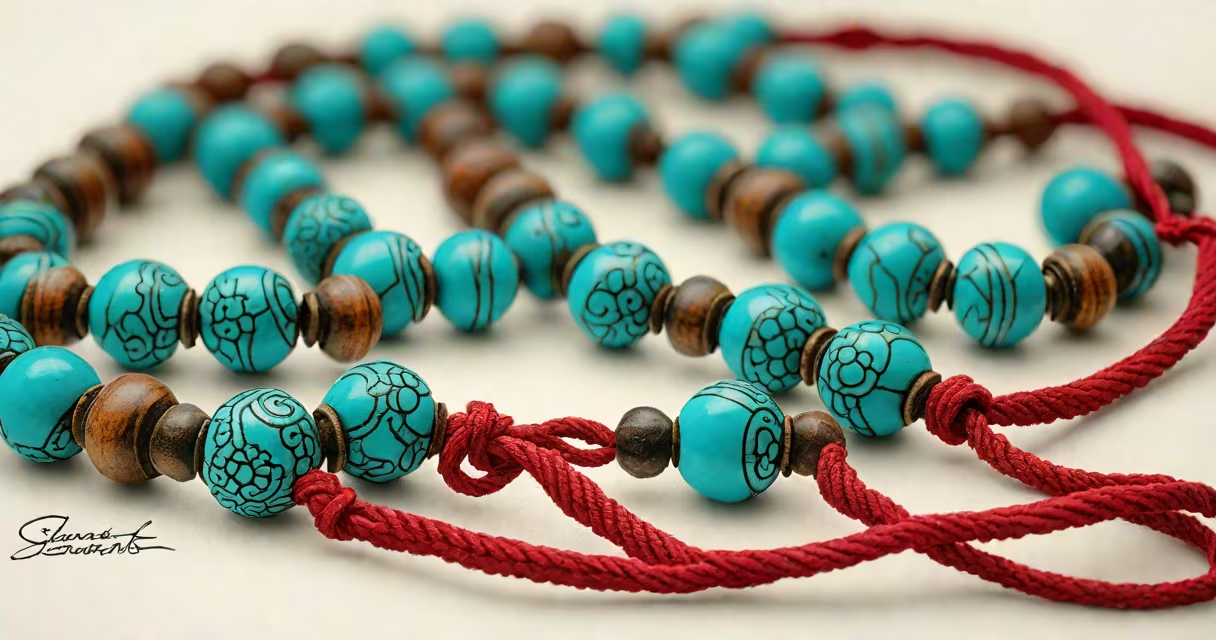
Tibetan Buddhist mala beads are 108-bead prayer strings traditionally used in meditation and mantra recitation to track repetitions and maintain mental focus during spiritual practice. They serve both ritual and symbolic functions within Tibetan Buddhist traditions.
Mala beads originated in ancient India and were adopted into Tibetan Buddhism through centuries of cross-cultural exchange. The standard mala consists of 108 beads, a number derived from sacred geometry and numerology in Buddhist cosmology. Each bead represents a cycle of thought, breath, or mantra. The larger central bead, called the guru bead, marks the completion of a full round and is typically not counted.
The materials used in authentic Tibetan mala beads reflect regional availability and spiritual significance. Common materials include sandalwood, bodhi seed, turquoise, coral, and lapis lazuli. Sandalwood mala beads are prized for their subtle fragrance and calming energy. Turquoise beads are believed to offer protection and clarity. Coral beads symbolize life force and vitality. These materials are selected not only for durability but for their perceived energetic properties.
During meditation, practitioners hold the mala in the right hand and move one finger along each bead with each utterance of a mantra. Starting at the bead adjacent to the guru bead, they progress through the 108 beads. Upon completing a full circuit, they reverse direction and continue. This tactile motion grounds attention and prevents mental drift.
A typical practice involves repeating a mantra such as "Om Mani Padme Hum" 108 times. Each bead corresponds to one repetition. The physical act of moving fingers from bead to bead reinforces mindfulness and reduces distraction. This method is especially effective for beginners who struggle with maintaining focus during extended sessions.
For example, a practitioner using a sandalwood mala with turquoise accents might begin their session by holding the mala in their dominant hand. As they whisper "Om Mani Padme Hum," they slide their thumb across each bead. After 108 repetitions, they pause, take three deep breaths, and reset. This routine can be done daily for 15 minutes, building consistency over time.
Different materials carry distinct associations in Tibetan Buddhist tradition. The choice of material often reflects personal intention or lineage affiliation.
| Material | Symbolism | Common Use |
|---|---|---|
| Sandalwood | Calm, purification, inner peace | General meditation, stress reduction |
| Bodhi Seed | Enlightenment, awakening | Practice focused on wisdom and insight |
| Turquoise | Protection, clarity, connection to nature | Healing practices, emotional balance |
| Coral | Vitality, strength, life force | Energy work, grounding rituals |
| Lapis Lazuli | Truth, spiritual awareness | Deep concentration, dreamwork |
Some malas feature a tassel or metal charm at the end. The tassel symbolizes the unbroken flow of compassion and wisdom. Metal charms may represent deities or protective symbols such as the endless knot or wheel of dharma.
Tibetan Buddhist mala beads are used in formal monastic settings and informal home practice alike. Monks in Tibetan monasteries use malas during morning and evening chanting sessions. Lay practitioners use them during personal meditation, prayer, or mindful breathing exercises.
They are not merely decorative. Their structure supports sustained attention. Research from the University of California, San Diego (2021) found that participants using tactile aids like malas during mindfulness training reported higher levels of focus and lower rates of mind-wandering compared to those using only verbal cues.
Malas are also used in specific rituals. For example, during the annual Losar festival in Tibet, monks chant mantras while rotating malas to mark the passage of time and invoke blessings for the coming year. The rhythmic movement aligns breath, sound, and touch, creating a multi-sensory meditative state.
Many people assume mala beads are interchangeable across cultures. This is incorrect. While similar objects exist in Hinduism, Jainism, and Sufism, Tibetan Buddhist malas have distinct design principles and symbolic meanings.
Another misconception is that malas must be handmade or sourced from Tibet to be authentic. While traditional malas are crafted in regions like Bhutan and Ladakh, modern production includes mass-manufactured versions. Authenticity lies in intent and proper use, not origin alone.
A lesser-known fact: the number 108 is not arbitrary. In Vedic mathematics, 108 is the product of 12 zodiac signs × 9 planets × 1 sun. In Tibetan Buddhism, it represents the 108 defilements or afflictions that must be purified through practice. This number appears repeatedly in mandala designs, prayer wheels, and ritual cycles.
I once observed a monk in Dharamsala, India, using a mala made of antelope bone and iron. He moved slowly, eyes closed, repeating a mantra in Tibetan. His fingers barely touched the beads, yet his entire posture exuded stillness. That moment confirmed what research later validated: the mala's function extends beyond counting-it becomes a vessel for presence.
Malas are not accessories. They are tools for transformation. Whether used in quiet meditation or public ceremony, they anchor the mind in awareness. Their value lies not in cost or rarity, but in consistent, intentional use.