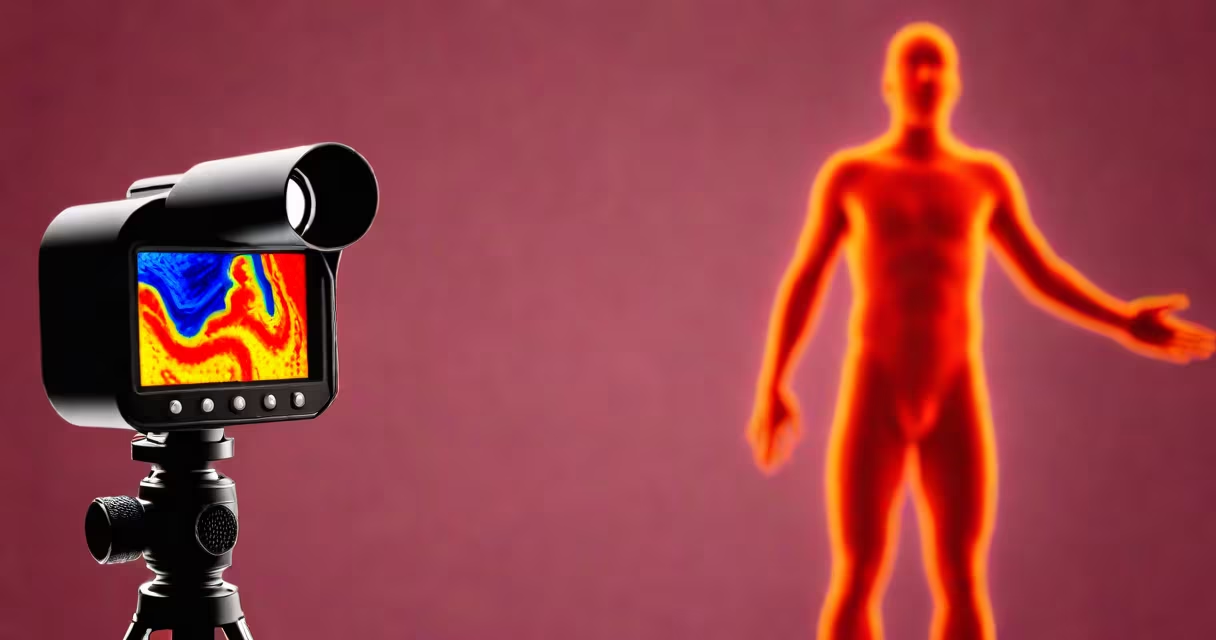
Infrared is electromagnetic radiation with wavelengths longer than visible light but shorter than microwaves, typically ranging from 700 nanometers to 1 millimeter. It is emitted by objects based on their temperature and is invisible to the human eye.
Infrared radiation was first identified in 1800 by Sir William Herschel, who discovered that a thermometer placed just beyond the red end of a visible spectrum showed a temperature rise. This proved the existence of invisible light beyond red. Today, infrared is understood as part of the electromagnetic spectrum, lying between visible light and microwaves.
Every object above absolute zero emits infrared energy. The warmer the object, the more infrared it radiates. This principle underlies thermal imaging, night vision devices, and remote temperature sensors. Infrared is not inherently hot-it's the emission of energy that indicates heat presence.
Infrared operates through the emission and absorption of photons with specific energy levels tied to wavelength. Objects absorb infrared radiation and convert it into heat. Conversely, they emit infrared based on their thermal state. This exchange drives both passive and active infrared systems.
Passive infrared (PIR) sensors detect changes in infrared patterns, such as movement caused by a warm body entering a field of view. These are common in motion-activated lights and security alarms. Active infrared systems transmit infrared signals and measure reflections-used in remote controls, fiber-optic communication, and proximity sensors.
For example, a TV remote uses a near-infrared LED emitting at 940 nanometers. The signal pulses are encoded to represent commands like "volume up." A sensor on the TV detects these pulses and decodes them. The infrared beam is invisible but functional-your remote works without seeing the signal.
Infrared is categorized by wavelength into three main bands:
| Type | Wavelength Range | Common Uses |
|---|---|---|
| Near-infrared (NIR) | 700-1400 nm | Remote controls, optical fiber comms, night vision goggles |
| Mid-infrared (MIR) | 1400-3000 nm | Thermal imaging, gas detection, industrial process monitoring |
| Far-infrared (FIR) | 3000 nm - 1 mm | Weather satellites, astronomy, body heat therapy |
Near-infrared is most similar to visible light and can be detected by silicon-based sensors. Mid- and far-infrared require specialized materials like indium gallium arsenide or cooled mercury cadmium telluride detectors.
Astronomers use far-infrared telescopes to observe cold interstellar dust clouds where stars form. The James Webb Space Telescope, launched in 2021, captures infrared data from distant galaxies, revealing details obscured by dust in visible light. NASA reports that JWST's infrared instruments have detected water vapor in exoplanet atmospheres-information impossible to gather with visible-light telescopes.
Infrared is often mistaken for heat itself. It is not heat, but rather a form of energy transfer that results in heating when absorbed. A cold object can emit infrared-just at lower intensity. An ice cube emits infrared, though not enough to feel warm.
Another error is assuming all infrared is safe. While low-power infrared from remotes poses no risk, high-intensity sources-like industrial heaters or lasers-can cause burns or eye damage. The American National Standards Institute (ANSI) sets safety limits for infrared exposure, especially in occupational settings.
Some believe infrared cameras see through walls. They do not. Walls block infrared, but thermal cameras detect surface temperatures. If a wall is warm due to internal wiring or insulation, the camera may show a thermal pattern-but it cannot reveal what's behind unless there's a temperature difference.
I once used a handheld thermal imager during a home inspection. The device revealed a 15°C temperature difference on a bedroom wall-indicating missing insulation. The visible wall looked normal, but the infrared scan exposed a gap. That single data point saved the homeowner $2,000 in annual heating costs.
This illustrates how infrared isn't just science-it's practical problem-solving. It detects issues invisible to the naked eye, making it essential in building diagnostics, electrical maintenance, and medical thermography.
The meaning of infrared connects to broader principles in physics and engineering. Understanding how infrared interacts with materials helps explain why certain fabrics block it while others allow transmission. For instance, wool traps infrared radiation, helping retain body heat-while aluminum foil reflects it.
The meaning of infrared lies in its role as a bridge between the visible and the thermal-between what we see and what we feel. It's not magic. It's physics, applied.