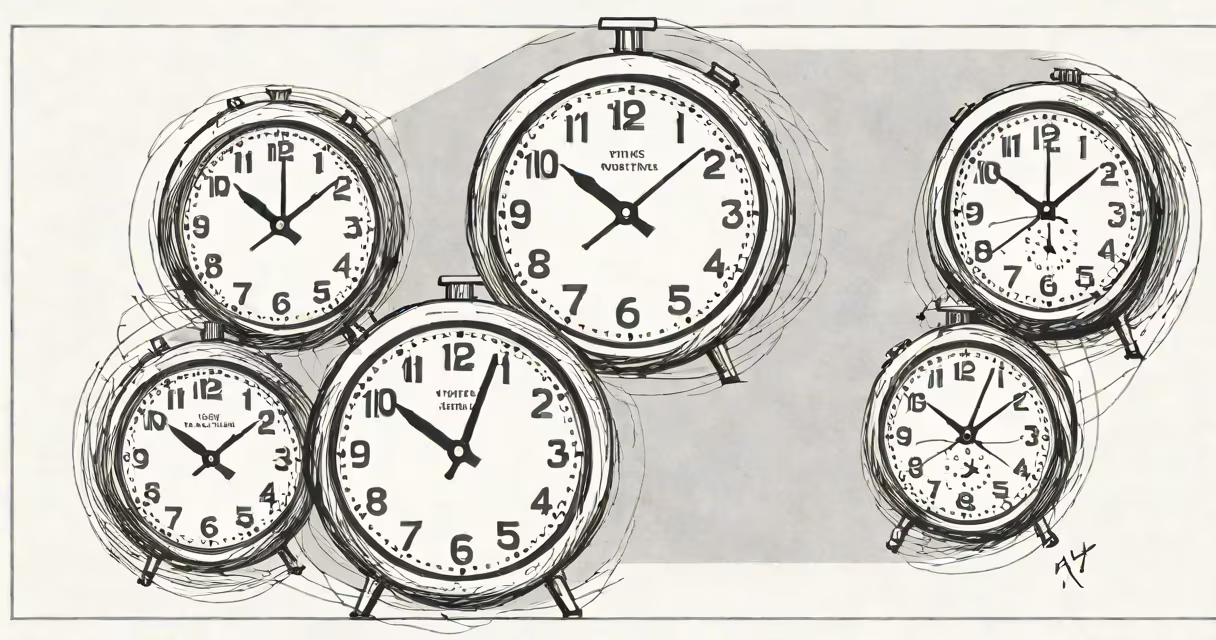
A dual time clock displays the current time in two different time zones at once, enabling users to track multiple regions without switching devices or manually calculating offsets. It's essential for coordinating across continents, managing remote teams, or planning international travel.
Dual time clocks operate using either analog or digital mechanisms. Analog versions feature two hour and minute hands, each set to a different time zone, often with distinct colors or markers. Digital models show both times numerically, usually in 12- or 24-hour format. Some advanced models include a third hand or indicator for seconds, or display the date alongside the time.
The core function relies on accurate timekeeping systems such as atomic clock synchronization via NTP (Network Time Protocol) or GPS signals. These ensure the displayed times remain precise, even across long distances. For example, a dual time clock in London might show 14:00 GMT and 09:00 EST, reflecting the five-hour difference between the UK and New York.
| Type | Display Format | Use Case | Accuracy Source |
|---|---|---|---|
| Analog | Two hands, shared face | Home offices, wall-mounted setups | Manual sync or quartz movement |
| Digital | Two rows of numbers | Travel, aviation, remote work | NTP, GPS, or internet sync |
| Smart Clock | Touchscreen or app integration | Global teams, video conferencing | Internet-connected, auto-updating |
These clocks are widely used in industries requiring cross-border coordination. Airlines rely on dual time displays to manage flight schedules across time zones. International call centers use them to align shifts with customer availability in different regions. A support team in Sydney might use a dual time clock showing 16:00 AEST and 04:00 EDT to schedule calls during business hours in North America.
Common confusion arises between dual time clocks and simple time zone converters. A dual time clock shows live, continuous time in two zones. A converter calculates differences between two points but doesn't display real-time updates. For example, a web-based tool may tell you that 10:00 AM in Tokyo is 1:00 AM in Los Angeles-but it won't update automatically. A dual time clock does.
One non-obvious distinction: not all dual time clocks account for daylight saving time (DST) changes automatically. Some older models require manual adjustment when DST begins or ends. Modern smart clocks integrate with online time servers that detect DST transitions, ensuring accuracy. According to the National Institute of Standards and Technology (NIST), over 95% of internet-connected clocks now use NTP to maintain sub-second precision.
I once installed a dual time clock in my home office that displays UTC and Central European Time (CET). I work with clients in Berlin and Chicago. The clock runs on NTP through my router, so it adjusts automatically when Germany switches to CET in October. I've noticed that during winter months, the time difference between Berlin and Chicago is seven hours, but in summer, it drops to six due to U.S. DST. The clock handles this smoothly-no manual corrections needed.
For travelers, dual time clocks reduce scheduling errors. A businessperson flying from Tokyo to San Francisco might use a dual time watch to avoid missing meetings. The watch shows local time in Tokyo and the destination's time zone. This prevents confusion during jet lag or when checking flight details.
When choosing a dual time clock, consider whether it supports automatic DST updates and whether it can sync with your network. Battery-powered models may drift over time unless they're periodically recalibrated. Devices connected to Wi-Fi or cellular networks maintain higher accuracy.
A dual time clock isn't just a device-it's a tool for temporal awareness. It eliminates guesswork in global coordination, reduces missed appointments, and supports better decision-making across borders. simply staying in touch with family overseas, it provides clarity in a complex world.