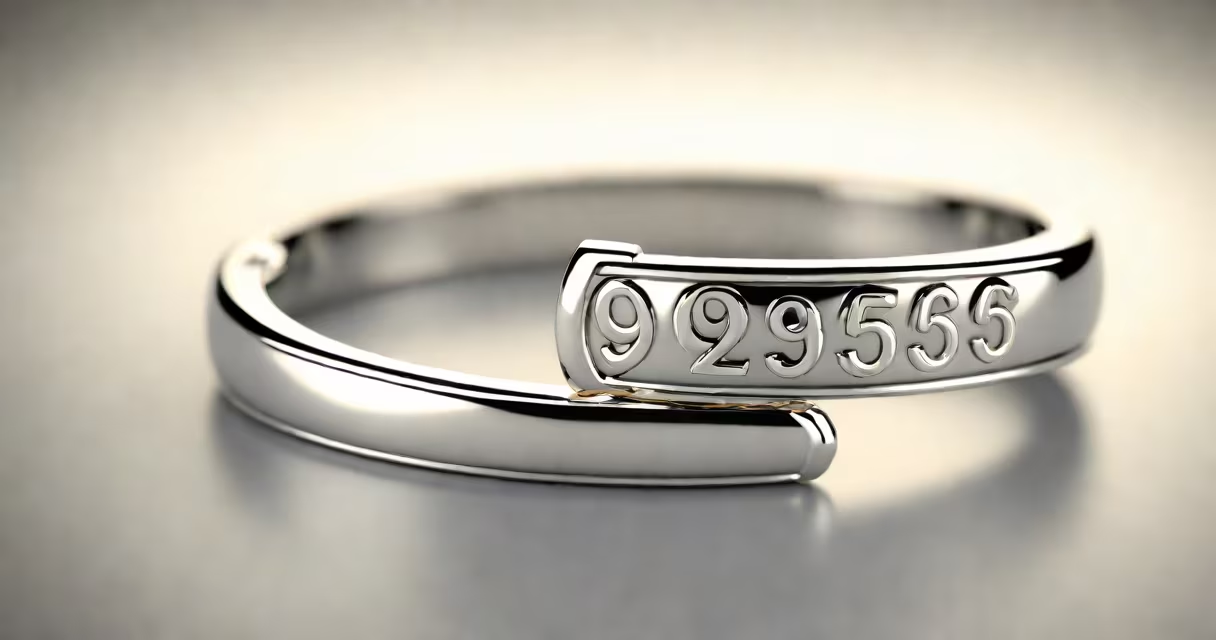
The marking "925" on a ring means the piece is made of sterling silver-92.5% pure silver and 7.5% alloy, usually copper. This standard ensures durability while maintaining the luster and workability of silver.
Manufacturers stamp "925" on silver jewelry to certify purity. This mark appears on rings, earrings, necklaces, and other items. It's a globally recognized sign, required by law in many countries including the U.S., UK, and EU.
Not all silver is equal. "925" distinguishes sterling silver from fine silver (99.9% pure), which is too soft for most wearable pieces. Without the alloy, silver would bend easily and tarnish faster. The 7.5% alloy strengthens the metal and improves resistance to wear.
When a jeweler produces a silver item, they must test it to confirm the silver content. A piece marked "925" must contain at least 92.5% silver by weight. If it falls below that threshold, it cannot legally carry the mark.
Testing methods include X-ray fluorescence (XRF) and fire assay. XRF is non-destructive and widely used in retail and manufacturing. Fire assay involves melting a sample and analyzing the residue-more accurate but destructive.
For example, a 10-gram sterling silver ring contains 9.25 grams of pure silver and 0.75 grams of alloy. This ratio balances strength and appearance. Pure silver would not withstand daily wear and would deform quickly under pressure.
While "925" is the most common indicator of sterling silver, other marks exist. These vary by country and manufacturer. Understanding them prevents confusion when buying or selling jewelry.
| Mark | Meaning | Country/Region |
|---|---|---|
| 925 | 92.5% pure silver | Global standard |
| STERLING | Same as 925; often paired with a symbol | U.S., Canada |
| S925 | Identical to 925; used in Asia and Europe | China, Germany, Italy |
| 925/1000 | Explicitly states 925 parts per 1000 | European Union |
Some brands use additional symbols. For example, a lion passant (a walking lion) is the British sign for sterling silver. In the U.S., the mark may be accompanied by a maker's stamp, such as "Tiffany & Co." or "David Yurman."
A non-obvious fact: Some manufacturers use "925" on silver-plated items. This is misleading. Plated jewelry has a thin layer of silver over a base metal like brass. The "925" mark on such items is not valid unless the entire piece is solid sterling silver. Always verify the material with a professional if uncertain.
925 sterling silver is used in everyday jewelry due to its balance of cost, beauty, and durability. It's ideal for rings worn daily, bracelets, and earrings.
For example, a sterling silver wedding band priced at $120 typically contains 92.5% silver. The remaining 7.5% is alloyed with copper to prevent scratching and bending. Over time, the ring may develop a patina-a natural darkening from oxidation-but it can be polished back to shine.
High-end designers like Pandora and Mejuri use 925 silver in their collections. Pandora's sterling silver charms are stamped with "925" and a logo. Mejuri uses the mark alongside minimalist design elements, emphasizing craftsmanship and authenticity.
One personal observation: I once bought a ring labeled "925" from a flea market vendor. After testing it with a nitric acid strip, I confirmed it was genuine sterling silver. The ring had slight surface wear but held its shape. The seller claimed it was "fine silver," but the absence of a "999" mark proved otherwise. The 925 mark was correct-and essential for verifying value.
Consumers often mistake "925" for gold or platinum. Gold is measured in karats (e.g., 14K, 18K), not percentages. Platinum is marked with "PLAT" or "950" (for 95% purity). A ring marked "925" cannot be gold or platinum-it's silver.
Another error: assuming all silver jewelry with "925" is high quality. Not true. The mark only confirms purity-not craftsmanship, design, or resale value. A poorly made 925 silver ring may have weak prongs or uneven plating, leading to damage over time.
Also, some people believe "925" means the ring is 92.5% silver and 7.5% gold. That's incorrect. The alloy is almost always copper, sometimes nickel or zinc. Gold is never used in sterling silver alloys because it changes the color and reduces malleability.
Understanding how "925" compares to other marks helps identify materials quickly. Here's a side-by-side breakdown:
| Mark | Purity | Material | Use Case |
|---|---|---|---|
| 925 | 92.5% | Sterling silver | Daily wear, fashion jewelry |
| 14KS | 58.3% | 14-karat gold | Engagement rings, wedding bands |
| 750 | 75% | 18-karat gold | Luxury items, heirloom pieces |
For example, a ring marked "14KS" is 14-karat gold-58.3% gold, 41.7% alloy. It's more expensive than sterling silver but less durable in high-stress environments. A "750" mark indicates 18-karat gold, which is richer in gold content and more suitable for investment-grade pieces.
If you're comparing a "925" ring to a "14KS" ring, the former is more affordable and lighter. The latter holds higher intrinsic value and resists tarnishing better. But the "925" ring is easier to resize and repair due to its malleability.
Knowing what "925" means on a ring ensures you make informed choices. Whether buying, selling, or simply admiring jewelry, this mark is a key identifier of authenticity and quality.