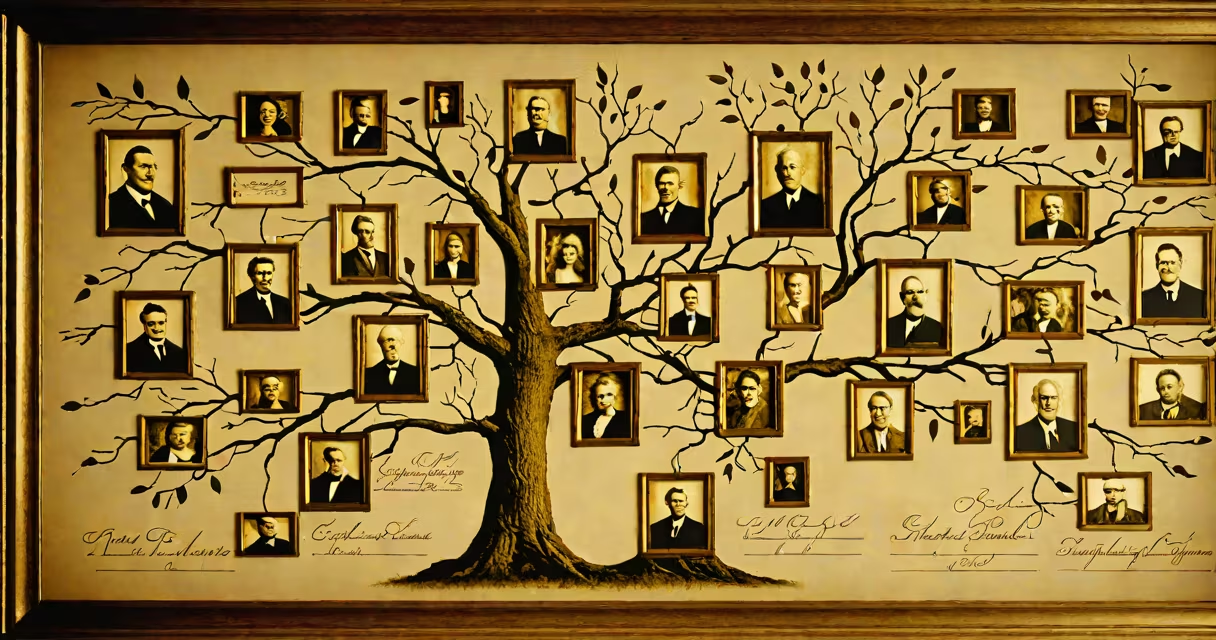
Genealogy is the systematic study of family lineages, tracing ancestral connections across generations using documents, oral histories, and genetic data. It identifies relationships, birthplaces, migrations, and life events to reconstruct family histories.
Modern genealogy combines traditional archival research with DNA analysis. Researchers begin with known relatives-parents, grandparents-and work backward through census records, birth certificates, marriage licenses, and immigration files. They verify facts, resolve discrepancies, and build detailed family trees.
The goal is not just to list names and dates but to understand how people lived, moved, and connected. A person might discover their great-grandfather emigrated from Italy during World War I, or that a maternal ancestor was enslaved and later freed under the 13th Amendment. These insights reveal both personal identity and broader social patterns.
Genealogists follow a process: collect existing information, identify gaps, locate records, evaluate sources, and connect evidence. Each step requires critical thinking. For example, a birth certificate may list a father's name, but if the child was born out of wedlock, the name may be inaccurate or omitted.
Researchers use standardized formats like the Genealogical Proof Standard (GPS), which requires five criteria: a reasonably exhaustive search, complete and accurate source citations, analysis and comparison of evidence, resolution of conflicting information, and a soundly reasoned conclusion. The GPS is endorsed by the Board for Certification of Genealogists (BCG).
A real-world example: a woman researching her mother's side finds a 1900 U.S. Census record listing her grandmother as "Mary Smith," born in Indiana. But the same record shows Mary's husband, John, listed as born in Germany. Cross-referencing ship manifests and naturalization papers confirms John was German-born and arrived in 1892. This corrects a long-held family belief that he was American-born.
Genealogical work relies on primary and secondary sources. Primary sources include original documents such as baptismal records, military service files, land deeds, and wills. Secondary sources are interpretations-books, articles, or online databases that summarize or analyze data.
DNA testing has transformed genealogy since the early 2010s. Autosomal DNA tests (like those from AncestryDNA or 23andMe) compare segments of DNA to estimate ethnic origins and identify potential relatives. Y-DNA testing traces paternal lines through the Y chromosome, while mtDNA analyzes maternal inheritance via mitochondrial DNA.
For example, a man with a rare surname-"Voss"-takes a Y-DNA test. His results show he shares a common ancestor with men in Norway and the Netherlands, suggesting his lineage originated in Northern Europe. This aligns with a 1780 church record showing a "Johannes Voss" arriving in New York from Bergen.
| Type | Focus | Best For | Common Source |
|---|---|---|---|
| Autosomal DNA | Recent ancestry (up to 5-6 generations) | Matching relatives, ethnic mix | AncestryDNA, 23andMe |
| Y-DNA | Paternal line (father's father's father...) | Deep-rooted surname history | FamilyTreeDNA, YFull |
| mtDNA | Maternal line (mother's mother's mother...) | Prehistoric migration paths | FamilyTreeDNA, Geno 2.0 |
Genealogy serves personal, academic, legal, and cultural purposes. Individuals trace roots to understand identity, heal intergenerational trauma, or reconnect with lost relatives. Adoptees often use DNA matching to find biological families.
Historians use genealogies to study population movements. The National Archives of the UK maintains over 10 million parish registers, many dating to the 16th century. Researchers have used these to map rural migration patterns during the Industrial Revolution.
Legal applications include proving descent for inheritance rights, citizenship claims, or Native American tribal enrollment. The U.S. Bureau of Indian Affairs requires documented lineage to prove blood quantum. In 2019, a court in Oklahoma ruled that a man could claim Cherokee Nation membership based on verified genealogical records and DNA evidence.
People often mistake genealogy for astrology or fortune-telling. Genealogy is evidence-based. It does not predict future outcomes-it explains past ones. A genealogist cannot determine whether a distant cousin will inherit wealth. They can only confirm shared ancestry.
Another misconception: genealogy is only for white Americans. In reality, it's important for marginalized groups. African American families were separated by slavery, and many records were destroyed. The Freedmen's Bureau records (1865-1872) are now digitized and used to rebuild family lines. The National Archives estimates that over 2 million formerly enslaved people appear in these files.
Some assume DNA results are definitive. But they're probabilistic. A test might show "45% British Isles ancestry," but that percentage varies slightly between labs due to reference populations. The University of Washington's Population Genetics Lab warns that ethnicity estimates should not be used as proof of national identity.
I once spent six months verifying a match between my grandfather's WWII draft card and a photograph of him in a 1943 Army base newspaper. The name matched, the date of birth aligned, and the photo showed the same scar above his left eyebrow. Only then did I trust the connection. That moment confirmed the power of cross-referenced evidence.
Genealogy focuses on facts-names, dates, locations. Family history adds narrative. It interprets those facts into stories: "My great-grandmother walked 20 miles to deliver medicine during the 1918 flu pandemic."
Genealogy provides the foundation. Family history builds meaning. One cannot exist without the other. A tree with 100 names is incomplete without context. A story without verified sources risks becoming myth.
Understanding what does genealogy mean begins with recognizing it as a disciplined pursuit of truth through documentation and science. It's not about romanticizing the past-it's about honoring it with accuracy.