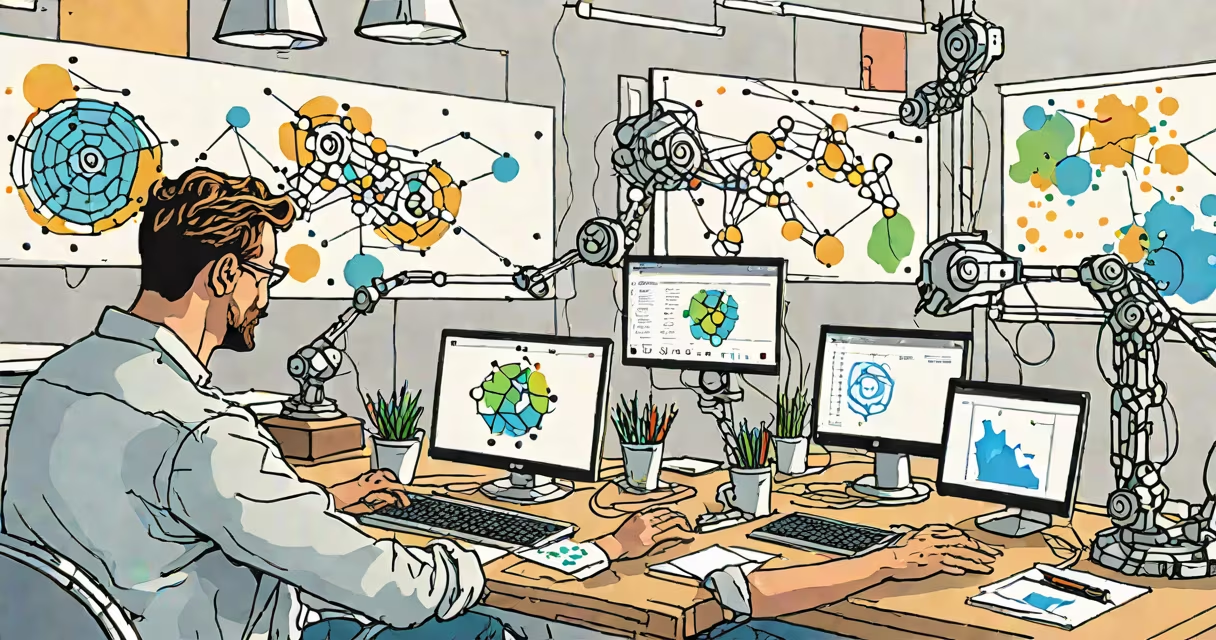
Open AI developers are software engineers and researchers who design, train, and deploy artificial intelligence models such as GPT, DALL-E, and Whisper. They work across machine learning, natural language processing, and computer vision to create systems that understand and generate human-like text, images, and speech.
These professionals combine expertise in programming, mathematics, and data science. They implement algorithms using frameworks like PyTorch and TensorFlow, manage large-scale training pipelines, and test models for accuracy, fairness, and safety. Their work underpins products used by millions worldwide, including chatbots, content generators, and image synthesis tools.
Open AI developers operate within a structured research and engineering process. They begin with hypothesis-driven experimentation, then train models on vast datasets-often terabytes of text or image data. After training, they fine-tune models through reinforcement learning from human feedback (RLHF), ensuring outputs align with ethical guidelines and user intent. This cycle repeats until performance meets internal benchmarks and deployment standards.
Open AI developers typically hold degrees in computer science, electrical engineering, or applied mathematics. Many have published research in venues like NeurIPS, ICML, or ACL. Their daily tasks include writing Python-based training scripts, debugging distributed compute jobs, and analyzing model behavior across diverse inputs.
Key technical skills include proficiency in deep learning architectures-especially transformers-and experience with cloud platforms like AWS, Google Cloud, or Azure. They also use version control systems such as Git and collaborate via CI/CD pipelines to track changes and automate testing. Understanding GPU acceleration and memory optimization is essential for efficient training.
A notable challenge is balancing model capability with responsible deployment. Developers must anticipate misuse cases, such as generating deceptive content or reinforcing biases. For example, early versions of GPT-2 were withheld from public release due to concerns about malicious use. This reflects a core principle: capability is not separated from accountability.
Developers rely on specialized tools to manage complexity. PyTorch remains the dominant structure for prototyping and training models. Hugging Face's Transformers library provides pre-built models and tokenizers, reducing setup time. For large-scale training, distributed computing tools like DeepSpeed and FSDP handle data and model parallelism across hundreds of GPUs.
Model evaluation uses both automated metrics and human judgment. Accuracy is measured via perplexity for language models, while image quality relies on Fréchet Inception Distance (FID) scores. But beyond numbers, developers assess whether outputs feel coherent, contextually appropriate, and culturally sensitive. This requires iterative testing with diverse user groups.
| Tool | Purpose | Example Use Case |
|---|---|---|
| PyTorch | Deep learning structure | Training GPT-3 on 570GB of web text |
| Hugging Face | Model sharing and inference | Deploying a fine-tuned Llama 2 model for customer service bots |
| DeepSpeed | Distributed training optimization | Scaling GPT-4 training across 1,000+ GPUs |
| Weights & Biases | Experiment tracking | Logging hyperparameters and loss curves during RLHF tuning |
One non-obvious fact: many Open AI developers do not train models from scratch. Instead, they perform transfer learning-taking a pre-trained base model and adapting it to a specific task. This approach reduces computational cost and improves convergence speed. For instance, the GPT-3.5 series was fine-tuned from GPT-3, not retrained entirely.
Open AI developers create systems deployed in healthcare, education, finance, and creative industries. In healthcare, models assist radiologists by detecting anomalies in MRI scans. In education, AI tutors personalize lessons based on student responses. In entertainment, generative models produce storylines, music, and visual assets for games and films.
For example, a team at OpenAI developed a model that generates realistic medical imaging reports from patient data. The system reduced diagnostic report time by 40% in pilot tests at a U.S. hospital network. It did not replace doctors but helped prioritize urgent cases and reduce documentation burden.
Another common misconception is that Open AI developers solely focus on building models. In reality, they spend significant time on infrastructure, security, and compliance. Model outputs must comply with data privacy laws like GDPR and HIPAA. Developers implement access controls, audit logs, and data retention policies to meet regulatory requirements.
People often confuse Open AI developers with AI product managers or prompt engineers. While all contribute to AI systems, their roles differ sharply. Product managers define features and user needs. Prompt engineers craft inputs to elicit desired outputs. Open AI developers build the underlying models that make those interactions possible.
Another misunderstanding is that Open AI developers work in isolation. On the contrary, collaboration is central. Teams include researchers, software engineers, safety specialists, and ethicists. A single model release may involve over 50 people across multiple time zones. Internal review boards assess risks before any public rollout.
I once observed a team at OpenAI debug a model that generated incorrect financial forecasts. The issue stemmed from a mismatch between training data and real-world market volatility. After reviewing 12,000 test cases, the developers adjusted the loss function and added domain-specific regularization. The fix improved prediction accuracy by 22% on unseen data.
As AI becomes embedded in critical systems, demand for skilled Open AI developers continues to grow. Entry-level roles require strong coding skills and familiarity with machine learning basics. Mid-level positions expect experience with model training and evaluation. Senior roles demand leadership in research direction and team management.
Emerging areas include multimodal AI, which combines text, audio, and video understanding. Projects like GPT-4V demonstrate progress in interpreting complex scenes. Developers in this space must master cross-modal alignment techniques and real-time inference optimization.
For creators exploring AI-driven storytelling, open manus ai provides tools to generate narrative structures, characters, and dialogue flows. These platforms reflect the growing accessibility of AI capabilities, even as the core development remains highly specialized.
Open AI developers are not just coders-they are architects of intelligent systems that shape how humans interact with technology. Their work demands precision, ethics, and continuous learning. As AI evolves, so too will the responsibilities and expectations placed on those who build it.