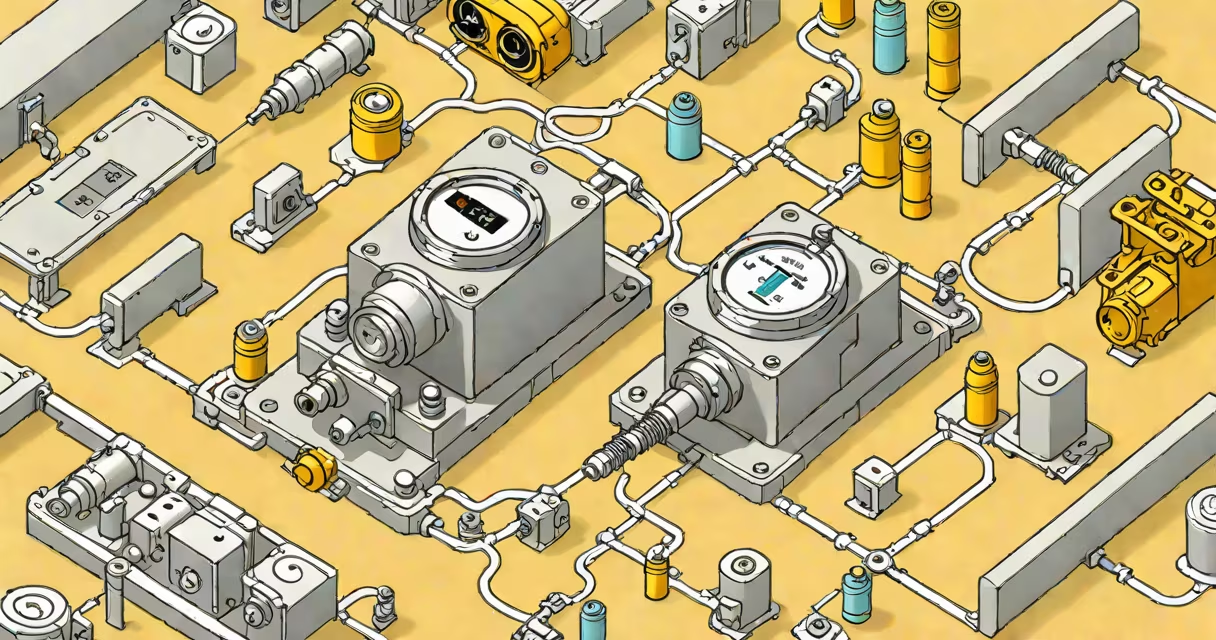
An absolute pressure unit measures pressure relative to a perfect vacuum, not atmospheric pressure. It reports the total force exerted by a fluid or gas, including atmospheric pressure. This differs from gauge pressure, which measures pressure above ambient conditions.
Absolute pressure is essential in thermodynamics, fluid dynamics, and engineering systems where precise reference points are required. Instruments like absolute pressure transducers and sensors use sealed reference chambers evacuated to near-zero pressure to measure deviations from vacuum. Common units include pounds per square inch absolute (psia), kilopascals absolute (kPa abs), and bars absolute (bar abs).
The International System of Units (SI) defines pressure in pascals (Pa), with 1 kPa = 1,000 Pa. A standard atmosphere (atm) equals 101.325 kPa, serving as a baseline for many scientific calculations. Absolute pressure readings are critical in altitude sensing, HVAC system calibration, and aerospace design.
Pressure arises from molecular collisions in fluids and gases. Absolute pressure quantifies the total energy per unit area exerted by these particles, measured from zero pressure-theoretical vacuum. Unlike gauge pressure, which subtracts local atmospheric pressure, absolute pressure includes it.
For example, at sea level, atmospheric pressure is approximately 14.7 psia. A tire inflated to 32 psi gauge pressure actually has an absolute pressure of 46.7 psia (32 + 14.7). This distinction prevents errors in systems sensitive to total pressure, such as engine combustion chambers or weather balloons.
Industrial sensors often use piezoresistive or capacitive elements to detect diaphragm deflection under pressure. These devices are calibrated against known vacuum references. A typical absolute pressure sensor may have a range of 0-100 kPa abs and an accuracy of ±0.5% of full scale.
Several units express absolute pressure. The most widely used are:
| Unit | Equivalent in kPa abs | Use Case |
|---|---|---|
| 1 psia | 6.895 kPa abs | Automotive and HVAC systems |
| 1 bar abs | 100 kPa abs | Weather reporting, industrial controls |
| 1 atm | 101.325 kPa abs | Chemical reactions, lab experiments |
| 100 kPa abs | 100 kPa abs | Reference point for many sensors |
Conversion between units requires consistent reference. For instance, 14.7 psia equals exactly 101.325 kPa abs. Misinterpreting psia as psi gauge leads to errors in system design-such as assuming a pump operates at 100 kPa when it's actually 100 kPa abs, resulting in incorrect flow predictions.
Aircraft altimeters rely on absolute pressure to determine elevation. As altitude increases, atmospheric pressure drops. Altimeters use calibrated absolute pressure sensors to convert pressure values into altitude readings via the International Standard Atmosphere model. At 1,500 meters, pressure is about 85 kPa abs-this value is used to set flight levels.
In semiconductor manufacturing, vacuum chambers operate below 100 Pa absolute pressure. Processes like chemical vapor deposition require pressures measured in millibars absolute (mbar abs). A chamber at 0.1 mbar abs corresponds to 10 Pa absolute-far below atmospheric pressure. Sensors must resolve changes within ±0.01 mbar abs to maintain process stability.
I once tested a vacuum pressure gauge unit on a laboratory vacuum pump. The device displayed 0.02 mbar abs, equivalent to 2 Pa absolute. When I compared it to a calibrated reference sensor, the difference was less than 0.001 mbar abs-within specification. This precision ensures clean environments for material deposition.
Many assume "pressure" without specifying absolute or gauge. In practice, this causes failures. For example, a compressor rated at 100 psig (gauge) delivers 114.7 psia. If a downstream valve is rated for 100 psia, it fails under actual operating pressure. Always verify whether a value is absolute or gauge.
Another error is using "bar" without "abs." Bar is a unit of pressure, but "bar" alone doesn't specify reference. A reading of 2 bar could mean 2 bar gauge or 2 bar absolute. In technical documentation, always use "bar abs" or "bar(a)" to avoid ambiguity.
Some instruments display both gauge and absolute modes. A dual-mode pressure gauge might show 30 psi gauge and 44.7 psia simultaneously. The user must select the correct mode based on application context. Industrial control systems often default to gauge unless explicitly configured for absolute.
Understanding the difference is important. Absolute pressure uses vacuum as zero. Gauge pressure uses atmospheric pressure as zero. A pressure of 0 psig at sea level equals 14.7 psia. Negative gauge pressure indicates vacuum, but negative absolute pressure is impossible-it implies less than zero force, which violates physical laws.
For example, a vacuum cleaner creating 20 inHg vacuum (inches of mercury) has a gauge pressure of -20 inHg. Converting to absolute: 20 inHg ≈ 6.8 kPa, so absolute pressure is 101.325 - 6.8 = 94.5 kPa abs. This shows how vacuum levels relate to absolute pressure.
When selecting sensors, ensure the unit specifies absolute or gauge. A sensor labeled "0-100 kPa" without qualification could mean gauge or absolute. Always confirm the reference point in datasheets. The manufacturer's specification sheet for a common industrial sensor lists "0-100 kPa abs" to clarify the reference.
Knowing the correct absolute pressure unit avoids system failure, ensures safety, and enables accurate modeling. Whether designing a high-altitude drone or calibrating a medical ventilator, absolute pressure provides the necessary reference for reliability and consistency.