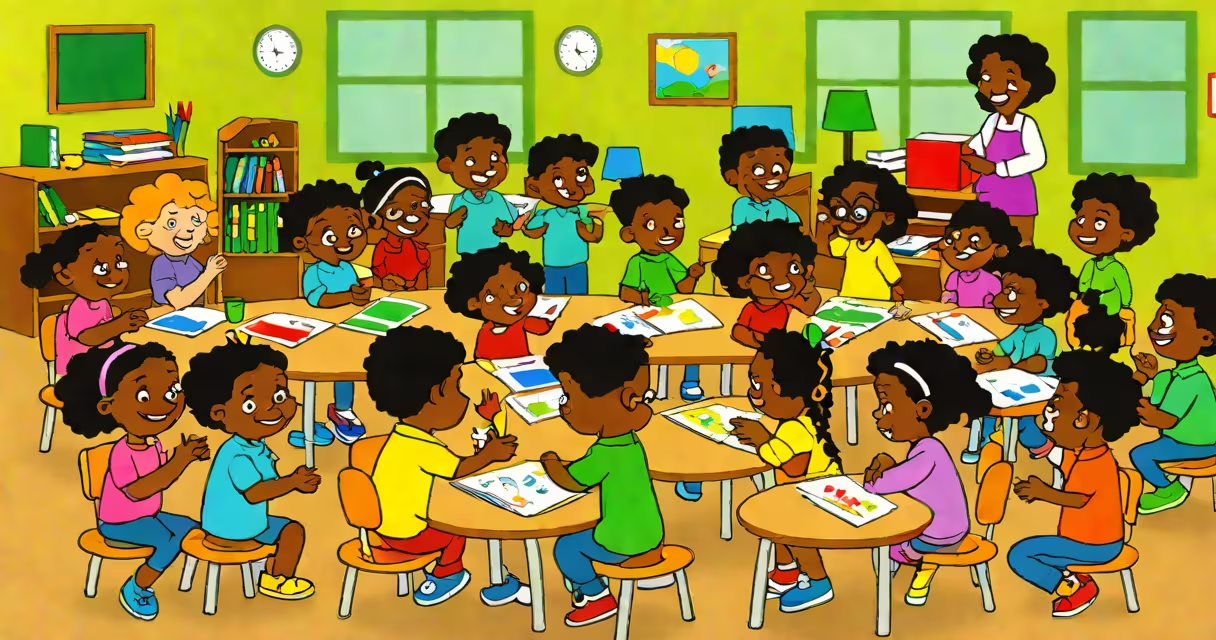
Pre-K 3 refers to the educational program for children aged 3 to 4 years old, designed to build foundational skills in literacy, math, social-emotional development, and motor coordination before formal kindergarten. This stage is part of early childhood education and often occurs in public school settings, private preschools, or licensed childcare centers.
Children in Pre-K 3 participate in structured yet playful activities such as storytelling, counting games, art projects, and group discussions. These experiences develop attention span, turn-taking, and basic problem-solving abilities. The goal is not academic mastery but readiness-equipping young learners with habits and confidence needed for success in kindergarten.
According to the National Association for the Education of Young Children (NAEYC), early childhood programs should be developmentally appropriate, meaning they match the cognitive, emotional, and physical capabilities of children at each stage. Pre-K 3 aligns with this principle by focusing on exploration, curiosity, and guided discovery rather than testing or rigid curricula.
Pre-K 3 classrooms operate on a daily schedule that balances free play, teacher-led activities, and routine transitions. A typical morning includes circle time, outdoor play, small-group instruction, snack, and creative expression through music or movement. Teachers observe behaviors closely to assess developmental progress and adjust support accordingly.
For example, a child who struggles to share toys may receive gentle redirection and modeling from the teacher. Over time, consistent routines and positive reinforcement help build self-regulation. Research from the University of California, Irvine shows that children who attend high-quality Pre-K 3 programs demonstrate stronger language acquisition and improved executive function compared to peers who do not.
Classroom environments emphasize safety, inclusivity, and sensory engagement. Walls display alphabet charts, number lines, and student artwork. Materials include blocks, puzzles, dress-up clothes, and manipulatives. These tools support learning through touch, sight, and interaction-critical for 3-year-olds still developing fine motor control and spatial awareness.
While most Pre-K 3 programs serve children between ages 3 and 4, exact entry criteria vary by state and district. Some schools accept children as young as 30 months, while others require enrollment by the child's fourth birthday.
| Program Type | Typical Age Range | Setting | Key Focus Areas |
|---|---|---|---|
| Public Pre-K 3 | 3-4 years | Elementary school campuses | Kindergarten readiness, social skills, early literacy |
| Private Preschool | 2.5-4 years | Independent facilities | Individualized learning paths, parent involvement |
| Head Start | 3-4 years (low-income families) | Community centers, schools | Complete services: health, nutrition, family support |
| Childcare with Pre-K Track | 3-4 years | Daycare centers | Basic routines, caregiver-child bonding, simple activities |
State policies differ widely. In New York City, Pre-K 3 is offered to all 3- and 4-year-olds regardless of income, funded through the universal Pre-K initiative. In contrast, Texas requires families to meet income thresholds or qualify through special education referrals to access state-funded Pre-K 3 seats.
A common misconception is that Pre-K 3 is equivalent to kindergarten. While both prepare children for school, Pre-K 3 focuses on development over academics. Kindergarten introduces letter recognition, phonics, and basic arithmetic-skills not formally taught in Pre-K 3. However, Pre-K 3 lays the groundwork for those later lessons.
Many parents assume Pre-K 3 is purely babysitting or informal playtime. This is incorrect. High-quality Pre-K 3 programs follow national standards set by NAEYC and the Council for Professional Recognition. Classrooms must have trained teachers, low child-to-staff ratios (typically 1:10), and documented learning goals.
Another misunderstanding is that age cutoffs are uniform. They are not. A child born in September may start Pre-K 3 at age 3, while a child born in August might wait until age 4. School districts often use a "cut-off date" (e.g., August 31) to determine eligibility. Parents should verify local policies with their school district.
One non-obvious fact: Pre-K 3 is not always free. While federal programs like Head Start cover costs for eligible families, many private and public Pre-K 3 programs charge tuition. In California, for example, families earning under $100,000 annually may qualify for subsidized care, but higher earners pay full rate. The average cost ranges from $150 to $300 per week depending on location and provider quality.
In a public Pre-K 3 classroom in Denver, Colorado, children arrive between 8:00 and 8:30 a.m. After greeting their teacher and hanging up backpacks, they choose from activity stations: building with magnetic tiles, painting with watercolors, or reading books with a partner. At 9:15 a.m., the class gathers in a circle for story time-"The Very Hungry Caterpillar." The teacher pauses to ask, "What do you think happens next?"
During snack time, children practice using spoons and napkins independently. The teacher models polite requests: "May I have the apple slices, please?" By 10:30 a.m., they move to the playground for 20 minutes of unstructured play. The teacher observes how children negotiate turns on the swing set and resolve conflicts verbally.
At dismissal, the teacher reviews the day's events with caregivers: "He shared his crayons during art and asked for help when stuck. He's improving in emotional regulation." This feedback loop ensures continuity between home and school.
I've observed this model firsthand while volunteering at a public Pre-K 3 center in Portland. The consistency of routines and intentional teaching moments stood out. Children weren't just playing-they were learning how to learn.
Research from the National Institute for Early Education Research (NIEER) shows that children who attend high-quality Pre-K 3 programs are more likely to graduate high school on time and less likely to need special education services. Gains in vocabulary, attention, and behavior persist into elementary school.
Pre-K 3 is not a luxury-it's a foundation. It supports equity by giving children from low-income families access to early learning opportunities that close achievement gaps. States investing in Pre-K 3 see long-term savings in remedial education and incarceration rates.