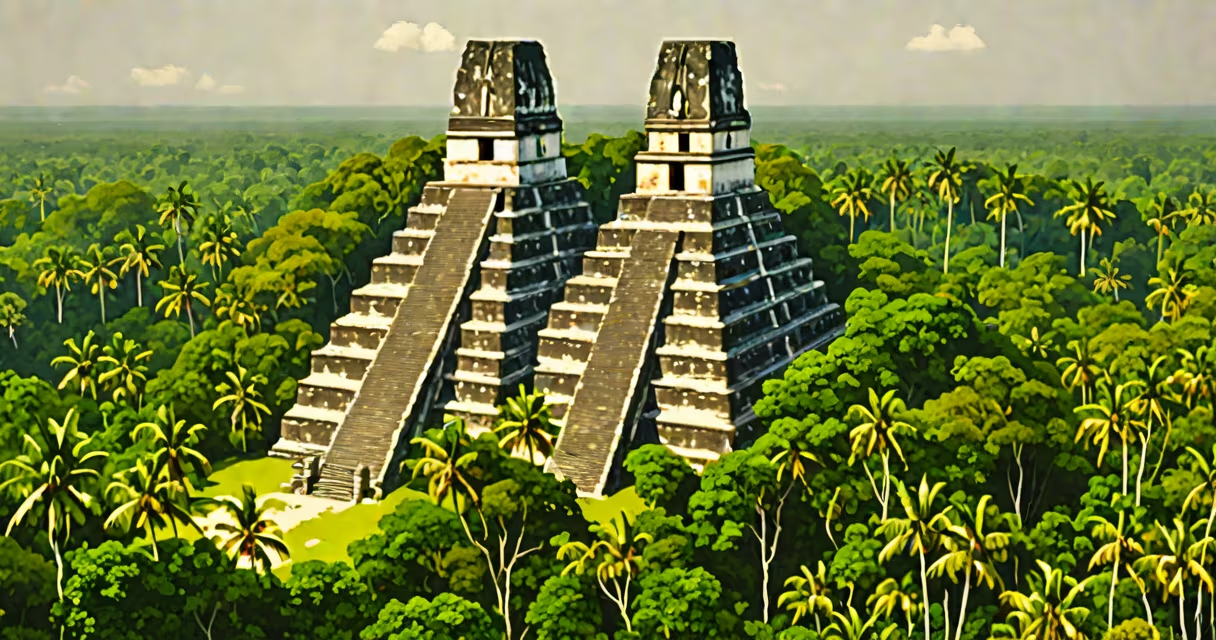
The Mayans are known for developing one of the most sophisticated pre-Columbian civilizations in the Americas, excelling in astronomy, mathematics, hieroglyphic writing, and monumental architecture. Their cities, such as Tikal and Chichén Itzá, feature towering pyramids aligned with celestial events, reflecting deep astronomical knowledge.
Mayan society emerged around 2000 BCE in Mesoamerica, centered in present-day southern Mexico, Guatemala, Belize, and parts of Honduras and El Salvador. By 250 CE, during the Classic Period, they had established useful city-states governed by divine kings who ruled through ritual, warfare, and trade. These centers were hubs of political power, religious ceremony, and intellectual achievement.
Mayan civilization reached its peak between 250 and 900 CE. While many cities declined by 900 CE due to environmental stress, warfare, and shifting alliances, their cultural and scientific contributions endured. Modern scholars continue to decode inscriptions and reconstruct their worldview from surviving artifacts and texts.
The Mayans developed a vigesimal (base-20) number system and were among the first in the world to use the concept of zero-a mathematical breakthrough that enabled complex calculations. This system supported their precise tracking of planetary cycles and eclipses.
They created a highly accurate calendar system combining the 260-day sacred calendar (Tzolkin) and the 365-day solar calendar (Haab'). Together, these formed the Calendar Round, cycling every 52 years. The Long Count calendar tracked longer periods, extending into thousands of years-used to record historical events and predict cosmic cycles.
For example, the Dresden Codex, a surviving Maya manuscript, contains detailed predictions of Venus's appearances and lunar eclipses. Calculations within it match modern astronomical data with less than 1% error over centuries. This accuracy was achieved using only naked-eye observations and mental arithmetic.
Mayan cities were designed around ceremonial centers featuring stepped pyramids, ball courts, palaces, and observatories. These structures were aligned with solstices, equinoxes, and planetary movements. At Chichén Itzá, the Kukulcán pyramid casts a serpent-like shadow during the spring and autumn equinoxes, demonstrating intentional astronomical design.
Buildings were constructed from limestone, carved with complex reliefs depicting gods, rulers, and mythological scenes. The Temple of the Inscriptions at Palenque houses the tomb of King Pakal, whose sarcophagus lid features a detailed cosmological scene showing his descent into the underworld.
Urban planning included raised causeways (sacbeob), water reservoirs, and terraced farming. At Calakmul, archaeologists found evidence of extensive irrigation systems supporting large populations in a tropical environment.
The Mayans developed the most advanced writing system in the pre-Columbian Americas. Their glyphs were logograms and syllabic signs, written in books called codices. Only four survive today-the Dresden, Madrid, Paris, and Grolier codices-due to Spanish colonial destruction.
These texts recorded royal lineages, military campaigns, religious rituals, and astronomical data. Inscriptions on stelae (stone monuments) at sites like Copán and Yaxchilán narrate dynastic histories in detail. For instance, Stela 29 at Copán records the reign of king Waxaklahun Ubah Kal, including his birth date and accession ceremonies.
Decipherment began in earnest in the 1950s, led by Yuri Knorozov, who proved that Mayan glyphs represented spoken language. Today, over 80% of known glyphs have been deciphered, allowing scholars to read entire passages from royal inscriptions.
Many assume the Mayans disappeared after the Classic Period collapse. But Maya-speaking communities still exist today, with over 7 million people identifying as Maya in Mexico, Guatemala, Belize, and Honduras. Modern Maya continue traditional practices, including agriculture, weaving, and spiritual ceremonies.
Another myth is that the Mayan calendar predicted the end of the world in 2012. The Long Count cycle ending on December 21, 2012, marked the close of a 5,126-year period-not a doomsday. It was akin to a millennium celebration in Western calendars, not a prophecy of annihilation.
The term "Maya" refers to a linguistic and cultural group, not a single nation. There were dozens of independent city-states, each with distinct rulers, dialects, and artistic styles. The idea of a unified "Mayan Empire" is inaccurate.
| Feature | Mayan Achievement | Global Context |
|---|---|---|
| Calendar Accuracy | Earth year calculated to 365.242 days | Matches modern value (365.2422) to within 0.0002 days |
| Mathematical System | Use of zero in base-20 system | Only three cultures independently developed zero: Mayans, Indians, and Babylonians |
| Writing System | Logosyllabic script with 800+ glyphs | One of only five fully developed writing systems in human history |
When I visited Tikal in 2018, I stood beneath the Temple of the Great Jaguar at dawn. As sunlight hit the eastern façade, shadows moved across stone carvings of celestial deities. That moment confirmed what epigraphy and archaeology show: the Mayans didn't just observe the sky-they built their world around it.
Today, the legacy of the Mayans lives on in modern Maya communities, UNESCO World Heritage Sites, and ongoing research. Their understanding of time, space, and ritual continues to inform archaeology, anthropology, and cultural studies. What are the Mayans known for? A civilization that mastered the stars, built enduring cities, and left a written record that still speaks across millennia.