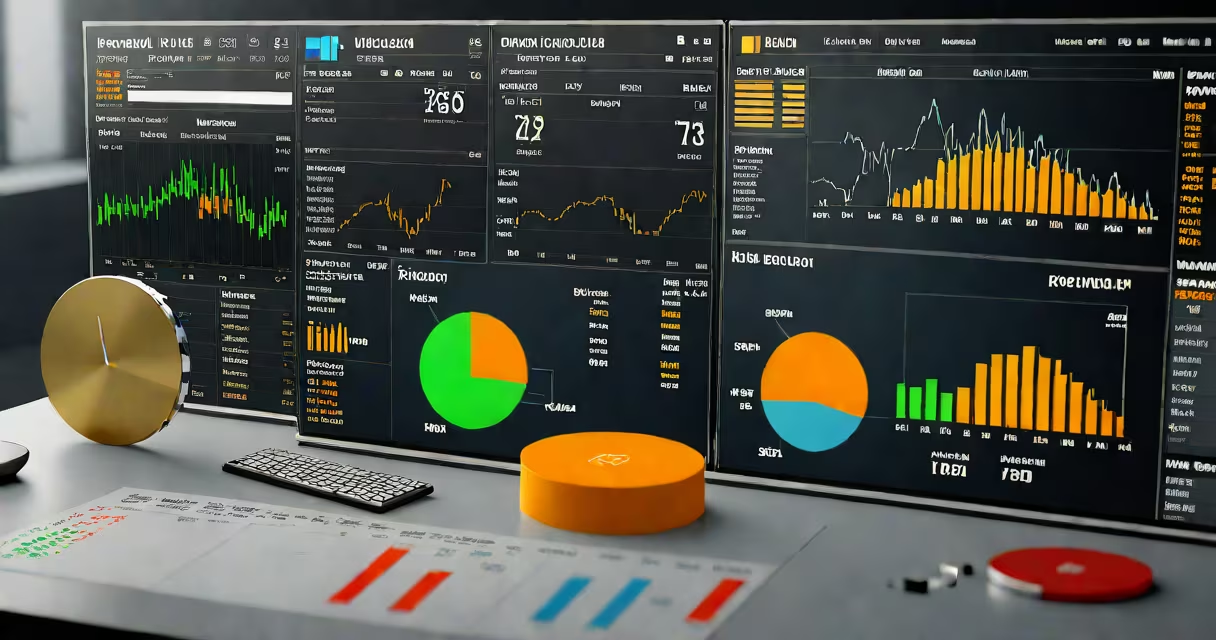
Financial projection software is a digital tool that models future financial performance based on historical data, current assumptions, and scenario variables. It generates forecasts for income, expenses, cash flow, and profitability over set timeframes-typically monthly or quarterly-for business planning, fundraising, and strategic decision-making.
These tools automate complex calculations that would otherwise require manual spreadsheet work. They allow users to adjust inputs such as sales growth rates, customer acquisition costs, or overhead changes and instantly see how those shifts affect projected outcomes. This enables faster, data-driven decisions across departments and leadership levels.
Major platforms like Adaptive Insights (now part of Workday), Planful, and Oracle's Hyperion offer enterprise-grade solutions. Smaller businesses often use QuickBooks Online Advanced, Float, or LivePlan, which integrate with accounting systems and support both basic and advanced modeling.
At its core, financial projection software uses a model structure built around key financial statements: income statement, balance sheet, and cash flow statement. Users define base assumptions-such as average order value, churn rate, or marketing spend per lead-and apply them across time periods.
The system then applies formulas to project revenues, subtract variable and fixed costs, calculate net profit, and track liquidity. For example, if a SaaS company assumes 15% monthly growth in subscribers and $50 average revenue per user (ARPU), the software projects $750 in monthly revenue per 15 new customers.
Advanced versions include Monte Carlo simulations, sensitivity analysis, and scenario toggling. A user can run "best case," "worst case," and "most likely" scenarios side-by-side to assess risk exposure. These features reduce reliance on gut instinct and improve alignment between finance, operations, and executive teams.
Financial projection software varies by complexity, integration capability, and target audience. The following table outlines common categories:
| Type | Best For | Example Tools | Key Features |
|---|---|---|---|
| Basic budgeting tools | Sole proprietors, startups | QuickBooks Online, LivePlan | Simple templates, drag-and-drop inputs, exportable reports |
| Mid-tier business planners | Growing SMBs, departments | Float, Forecast, ProfitWell | Real-time cash flow tracking, integration with Stripe or Shopify |
| Enterprise financial planning | Larger companies, public firms | Planful, Adaptive Insights, Anaplan | Multi-dimensional modeling, AI-driven anomaly detection, audit trails |
Many tools now include automated data ingestion from accounting software (e.g., Xero, NetSuite) and CRM systems (e.g., Salesforce). This reduces manual entry errors and ensures projections reflect actual transaction history.
A lesser-known but critical feature is version control. Financial projection software allows users to save multiple iterations-like "Q3 Forecast v2.1" or "Fundraising Scenario A"-and compare them side-by-side. This prevents loss of context during revisions and supports transparent reporting to investors or board members.
One frequent error is treating financial projection software as a standalone decision engine. It doesn't replace judgment-it amplifies it. The tool outputs numbers based on inputs. If assumptions are flawed, results will be misleading. As the Association for Financial Professionals notes, "model accuracy depends heavily on input quality, not just software capability."
Another confusion arises between financial projection software and accounting software. While both handle financial data, they serve different purposes. Accounting software records past transactions (e.g., invoices paid, payroll processed). Financial projection software predicts future states based on those records and external factors.
For example, a restaurant chain using Toast for POS data and QuickBooks for bookkeeping can feed that into Float to project cash flow for the next 12 months. If the system shows a negative cash balance in December due to holiday staffing increases, management can act early-adjust hiring plans, delay equipment purchases, or secure a line of credit.
I once worked with a nonprofit that used LivePlan to build a five-year sustainability plan. They entered donor retention rates, grant cycle timelines, and program expansion costs. The software revealed a funding gap in Year 3. That insight led them to revise their outreach strategy and secure a matching grant before the shortfall occurred. Without the tool, the issue might have emerged too late to fix.
Not all financial projection software offers equal transparency. Some platforms hide logic behind black-box algorithms or lack export options for independent validation. Always verify whether you can access raw formulas, export data in CSV or JSON format, and audit changes over time.
Also, avoid tools that lock you into proprietary formats. A 2023 study by Gartner found that 43% of small businesses switching platforms faced data migration delays due to incompatible file structures. Choose software that supports standard formats and clear documentation.
Finally, remember that financial projection software is not a substitute for financial literacy. Even the most useful tool fails if users don't understand concepts like burn rate, EBITDA margin, or compound growth. Training and ongoing review are essential.
When used correctly, financial projection software transforms uncertainty into actionable insight. It turns vague goals into measurable milestones and helps organizations anticipate challenges before they arise. managing a team, this category of software provides a structured way to test ideas and align resources.