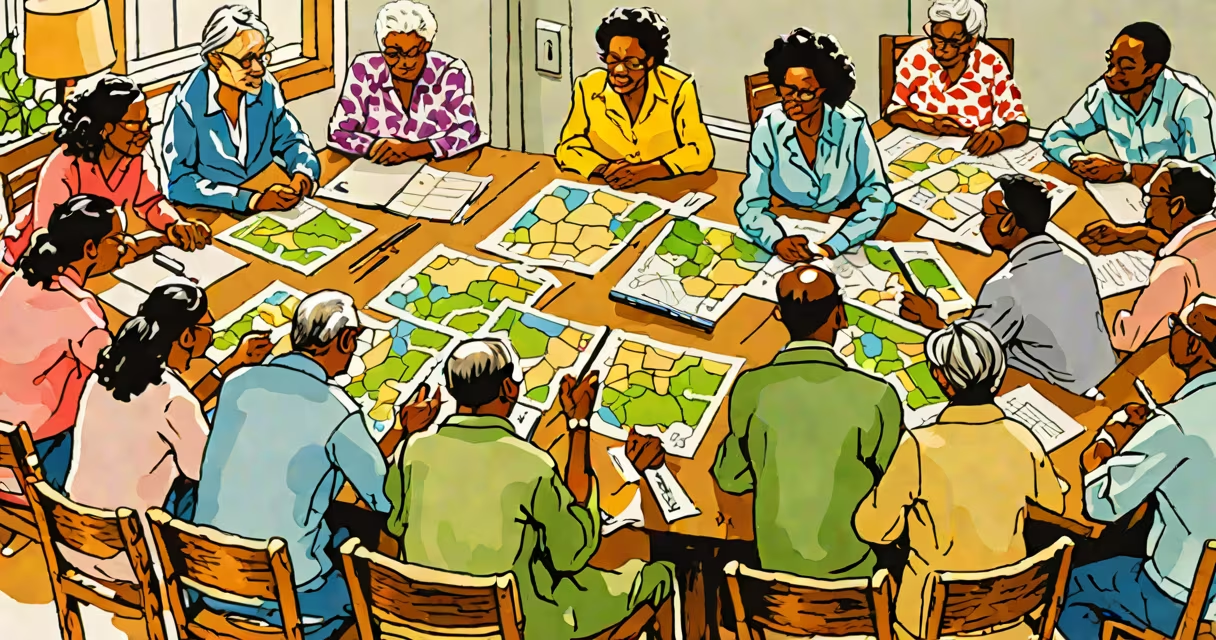
A community trust is a legal structure that holds assets-such as land, buildings, or funds-for the benefit of a specific community, managed through democratic governance rather than private ownership. It ensures lasting control and accountability, preventing asset sale or privatization by external actors.
Unlike standard nonprofits, which often rely on grants or donations and may dissolve if funding stops, a community trust aims to endure indefinitely. It operates under a charter or bylaws that define who qualifies as a member, how decisions are made, and how benefits are distributed. The trust's board typically includes elected representatives from the community, ensuring local voices shape outcomes.
Community trusts emerged in the U.S. during the late 20th century as tools for preserving cultural heritage, managing affordable housing, and protecting green spaces. They are especially common in urban neighborhoods facing displacement due to development pressure. According to the National Council of Nonprofits, such trusts allow communities to retain economic and environmental benefits from local resources over generations.
At its core, a community trust functions as a fiduciary entity. This means it legally owes a duty to act in the best interest of the community it serves. Trustees-individuals or a governing body-are responsible for managing assets, approving projects, and reporting outcomes annually. Decisions are made through consensus or voting, depending on the trust's constitution.
Trusts can hold physical assets, intellectual property, or financial capital. A trust managing a community-owned wind farm, for instance, collects revenue from electricity sales and reinvests it into local infrastructure or education. The trust's mission is embedded in its legal structure, making it harder to alter without broad community consent.
Community trusts are established under state law, most commonly as nonprofit corporations or charitable trusts. Some states, including New York and Vermont, have passed legislation allowing "community benefit corporations" with special protections. These forms offer liability shields and tax exemptions similar to 501(c)(3) organizations but with stronger community oversight requirements.
| Form | Best For | Key Feature |
|---|---|---|
| Nonprofit Corporation | Long-term asset management | Can apply for federal tax exemption; requires annual reporting |
| Charitable Trust | Land or real estate preservation | Assets remain in trust forever; beneficiaries are defined groups |
| Benefit Corporation | Hybrid profit/nonprofit models | Legally bound to consider social and environmental impact alongside profit |
Each model enforces different levels of transparency. Nonprofit corporations must file Form 990 annually with the IRS. Charitable trusts require public disclosure of trustees and major transactions. Benefit corporations are subject to shareholder lawsuits if they fail to meet stated goals.
People often confuse a community trust with a cooperative or a mutual aid group. While all three involve shared responsibility, their legal frameworks differ. A cooperative is owned by its members, who vote on operations and share profits. A community trust, however, holds assets on behalf of a broader population-even those who don't directly participate in daily decisions.
Another confusion arises with community foundations. Foundations distribute grants and manage endowments, but they do not own physical assets or make direct operational decisions. A community trust, by contrast, actively manages land, buildings, or enterprises. For example, the Harlem Children's Zone Trust manages charter schools, health clinics, and housing units-all under one governance model.
Some assume that community trusts are only for low-income areas. That's incorrect. High-income communities use them too. In Boulder, Colorado, a community trust was formed to preserve open space around the city's edge. The trust acquired 600 acres through a public bond measure and now oversees conservation, recreation access, and climate resilience planning.
In 2018, residents of Southside, a historically Black neighborhood in Atlanta, formed a community trust to prevent displacement. They purchased six rental properties using a mix of municipal grants and private donations. The trust now leases units at below-market rates to long-term residents.
Each year, the trust holds a town hall where members vote on budget allocations. In 2022, $42,000 was approved for roof repairs on three units, while $18,000 went toward installing solar panels. The trust's annual report, published online, shows that 94% of residents rated their living conditions as stable or improving since joining.
This model avoids the pitfalls of traditional housing nonprofits, which often prioritize donor interests or government contracts over resident needs. The Southside trust operates independently, with no outside board members. Decision-making power rests entirely with the community.
After testing the model for five years, the city council passed an ordinance allowing community trusts to issue bonds backed by future rental income-a move that expanded access to capital for similar initiatives nationwide.
A community trust is not a temporary fix or symbolic gesture. It is a durable legal structure for collective stewardship. Its strength lies in separating ownership from control: assets stay in the community, but decisions are made through transparent, inclusive processes. This structure prevents asset stripping and ensures continuity across generations.
When properly implemented, a community trust becomes a living institution-not just a document on paper. It reflects the values, priorities, and resilience of the people it serves. Understanding what is a community trust begins with recognizing that it is not a charity, nor a business, nor a government agency-but something distinct: a vehicle for enduring community power.