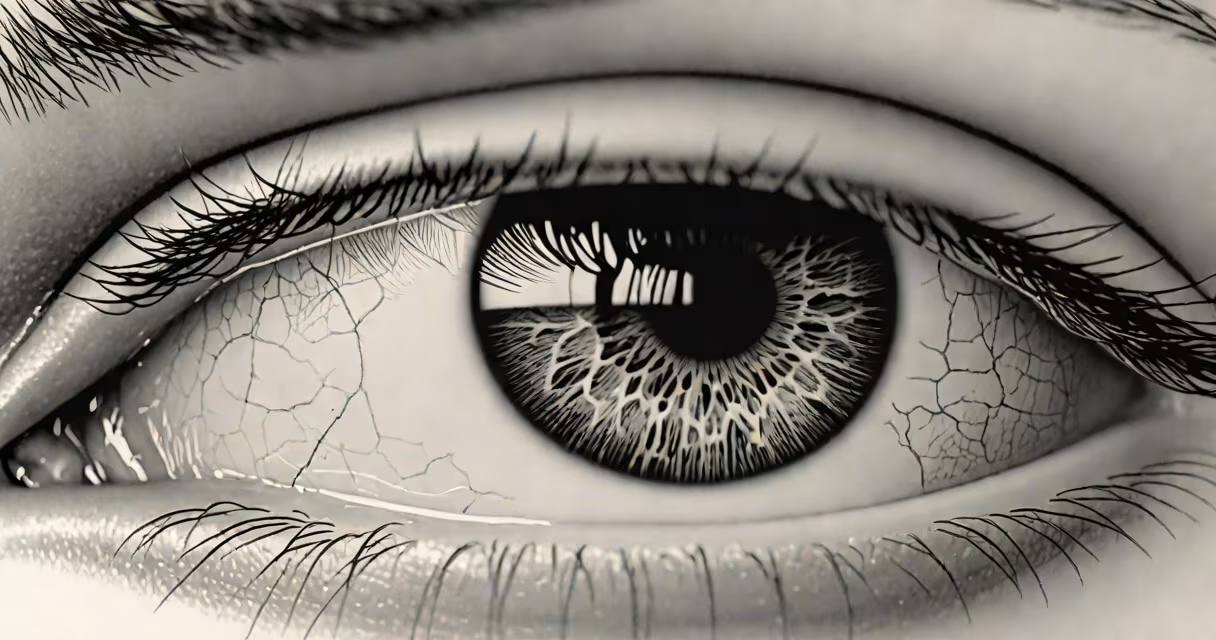
Static vision is the perception of a stable, unmoving visual scene during sustained fixation, relying on neural processing in the retina and primary visual cortex to maintain consistent spatial representation despite minor eye movements.
When you fixate on a single point-like reading a word on a page or staring at a painting-the image remains steady on your retina. This stability is not due to perfect stillness of the eyes, which make tiny involuntary movements called microsaccades. Instead, static vision emerges from the brain's ability to integrate sensory input and suppress motion signals during fixation. Without this mechanism, the world would appear to jitter constantly.
Static vision is distinct from motion vision, which detects changes in position over time. While motion vision activates different pathways in the visual system-particularly the dorsal stream-static vision depends on the ventral stream and the precise alignment of photoreceptors in the fovea. A failure in static vision can indicate neurological issues such as occipital lobe damage or retinal disease.
The process begins in the retina, where photoreceptors convert light into electrical signals. These signals travel via the optic nerve to the lateral geniculate nucleus (LGN) in the thalamus, then to the primary visual cortex (V1) in the occipital lobe. Here, neurons respond selectively to specific features-edges, contrast, orientation-forming a stable map of the visual field.
Even though the eyes move slightly every second, the brain compensates using internal models of eye position. This is known as corollary discharge: a copy of motor commands sent to the visual areas to predict how the image will shift. By comparing predicted shifts with actual input, the brain cancels out motion signals, preserving static perception.
A clinical example: patients with damage to the superior colliculus may report that stationary objects appear to drift or shimmer. This condition, called oscillopsia, results from disrupted integration between eye movement signals and visual feedback-showing how fragile static vision is when neural circuits fail.
Static vision is not a single function but a set of interdependent processes. The following table outlines key elements:
| Component | Description | Function |
|---|---|---|
| Foveal vision | High-resolution central vision | Provides detailed static images; responsible for reading and facial recognition |
| Peripheral stabilization | Suppression of motion in outer visual fields | Prevents distraction from moving stimuli during fixation |
| Fixational eye movements | Microsaccades, drifts, and tremors | Prevent neural adaptation; maintain sensitivity to static inputs |
Without microsaccades, prolonged fixation leads to fading of the image-a phenomenon called Troxler's fading. After 10-30 seconds of staring at a fixed point, peripheral details disappear because neurons stop responding to constant stimulation. Microsaccades refresh the signal, maintaining static vision.
One non-obvious fact: static vision relies on continuous neural noise. Research from the University of California, Berkeley, shows that spontaneous activity in V1 neurons contributes to perceptual stability. Even in darkness, these neurons fire randomly-but their patterns align with expected visual input, helping the brain distinguish real signals from noise.
Static vision is often mistaken for "stillness" in the environment. But the visual world is never truly still. The brain constructs stability through predictive coding, not passive reception. What we perceive as static is an active reconstruction.
Another confusion arises with motion illusions. For example, the "phi phenomenon"-where two flashing lights create the illusion of motion-can trick the brain into perceiving movement even when nothing moves. This highlights that static vision is not guaranteed by physical immobility. The brain interprets patterns based on timing and context.
Some assume static vision is purely optical. But it's fundamentally neurological. Damage to the visual cortex-even without retinal injury-can cause cortical blindness, where the eyes work normally but the brain fails to generate a stable image. Patients report seeing nothing, even though their pupils react to light.
Static vision testing is used in diagnosing neurological disorders. For instance, in multiple sclerosis, lesions in the optic radiation can disrupt the transmission of static visual signals, leading to blurred or unstable vision during fixation. Standard tests include the Amsler grid, which reveals distortions in the central visual field.
In ophthalmology, static vision assessment helps detect early macular degeneration. The macula, responsible for high-acuity static vision, deteriorates slowly. Patients may not notice until 30% of photoreceptors are lost. Screening tools like the ETDRS chart measure static acuity under controlled lighting and fixation conditions.
I once observed a patient with suspected migraines who reported "seeing static lines" during aura episodes. Upon examination, the lines were not in the environment but appeared as persistent scotomas in the central field-indicating transient disruption of static vision mechanisms. This case underscored that static vision is not just about seeing, but about seeing consistently.
Static vision is the brain's construction of a stable visual world during fixation, achieved through coordinated retinal input, eye movement control, and cortical processing. It is not passive observation but an active, changing process essential for daily tasks like reading, driving, and recognizing faces. Understanding static vision reveals how perception depends less on the external world than on internal neural architecture.