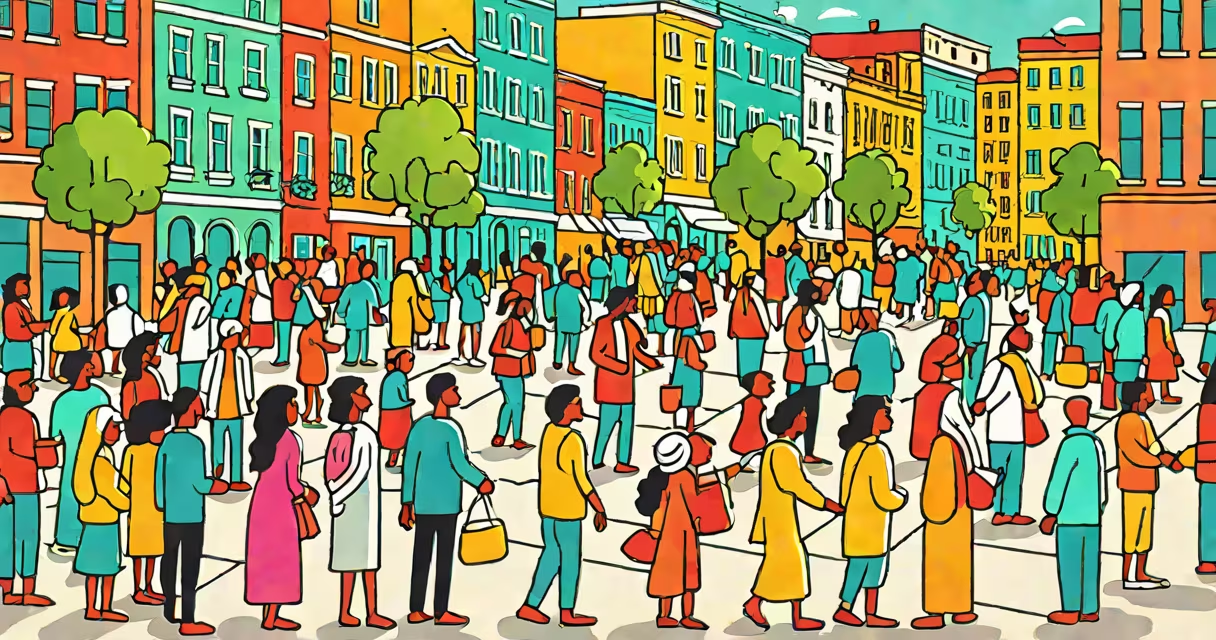
A pluralistic society is a community where multiple cultural, religious, ethnic, and ideological groups coexist under shared laws and institutions while maintaining distinct identities and practices. No single group holds exclusive power or dominance.
This model contrasts sharply with assimilationist systems, where minority groups are expected to adopt the dominant culture's norms. In a pluralistic society, differences are not erased but acknowledged as part of national identity. The United States, Canada, and Germany exemplify this structure through legal protections for religious expression, multilingual education, and inclusive civic participation.
According to the U.S. Department of State, pluralism supports democratic resilience by enabling diverse voices to influence policy. The Pew Research Center notes that countries with high levels of religious and ethnic pluralism report higher trust in government institutions compared to homogenous societies.
Power is distributed across institutions rather than concentrated in one group. Courts, legislatures, and public services operate under impartial rules that apply equally to all citizens regardless of background. This ensures fairness and reduces conflict over representation.
For example, in Canada, federal law mandates bilingualism in official communications. Provincial governments may offer services in Indigenous languages like Cree or Inuktitut. These policies reflect institutional commitment to linguistic pluralism, not symbolic gestures.
Local governance often includes advisory councils composed of representatives from various communities. In Toronto, the City Council established the Multiculturalism Advisory Committee to review policies affecting immigrant populations. This structure prevents marginalization and improves responsiveness to diverse needs.
Pluralism operates through several interlocking mechanisms:
| Type | Description | Real-world example |
|---|---|---|
| Cultural pluralism | Recognition of distinct cultural traditions within a nation | France's ban on religious symbols in public schools contrasts with Belgium's allowance of hijabs in classrooms |
| Religious pluralism | Legal protection for varied faith practices | India's constitution guarantees freedom of religion despite majority Hindu population |
| Political pluralism | Multiple parties and interest groups shaping policy | Germany's proportional voting system allows small parties to hold parliamentary influence |
Not all pluralism is stable. When institutions fail to enforce neutrality, tensions escalate. The 2005 French riots following the ban on headscarves in schools revealed how state-led assimilation can trigger backlash. Conversely, Sweden's integration model-offering language training and job placement alongside cultural recognition-has reduced youth unemployment among migrant communities by 18 percentage points between 2010 and 2020.
Pluralism is not synonymous with multiculturalism. While both value diversity, multiculturalism often implies a policy of celebrating difference, sometimes leading to segregated enclaves. Pluralism demands equal access to civic life and shared responsibility for societal well-being.
Some assume pluralism leads to chaos. But research from the University of Chicago shows that nations with formal pluralist frameworks have lower rates of civil unrest. In 2021, the World Bank ranked Norway, New Zealand, and Singapore among the top ten most stable countries-each with strong pluralist institutions.
Another misconception is that pluralism requires constant compromise. In reality, it relies on clear constitutional boundaries. For instance, the U.S. Supreme Court ruled in *Employment Division v. Smith* (1990) that religious exemptions cannot override neutral laws. This decision upheld the principle that individual rights exist within a structure of universal obligations.
The Netherlands hosts over 160 recognized religious communities. Public schools offer "religious education" options based on parental choice. A student whose family practices Islam may attend a school offering Islamic studies alongside Dutch history and science.
However, the state maintains strict separation between religion and public policy. In 2019, the Dutch Constitutional Court struck down a proposed law allowing mosques to administer marriage certificates under Sharia law. The court ruled that such arrangements would undermine equal treatment under civil law.
This balance-respecting belief while preserving legal equality-defines effective pluralism. It avoids both state-enforced uniformity and religious autonomy that undermines citizenship rights.
I observed this changing firsthand during a visit to Amsterdam's Westerpark neighborhood. There, a synagogue, a mosque, and a Hindu temple stand within 300 meters of each other. Community events are hosted jointly by all three houses of worship. They share space for interfaith dialogues, funded by municipal grants. No one claims superiority. All agree on the importance of mutual respect and adherence to national law.
When I asked a local imam about challenges, he said, "The real test isn't tolerance-it's consistency. When the police protect a mosque during a protest, and the mayor attends Eid prayers, that's when pluralism becomes visible."
Without pluralism, societies risk polarization. Minority groups face exclusion, and majoritarian rule can erode fundamental rights. In contrast, pluralistic systems promote innovation and stability. A 2022 OECD study found that countries with inclusive civic structures had 22% higher GDP growth over five years compared to those with rigid identity hierarchies.
Pluralism also strengthens democratic legitimacy. When people see themselves reflected in institutions, they are more likely to participate. Voter turnout in cities with solid pluralist policies averages 15 percentage points higher than in homogeneous areas.
Understanding the pluralistic society definition is essential for anyone engaging with modern civic life. It is not a theoretical ideal-it is a functional system that enables peaceful coexistence amid deep diversity.