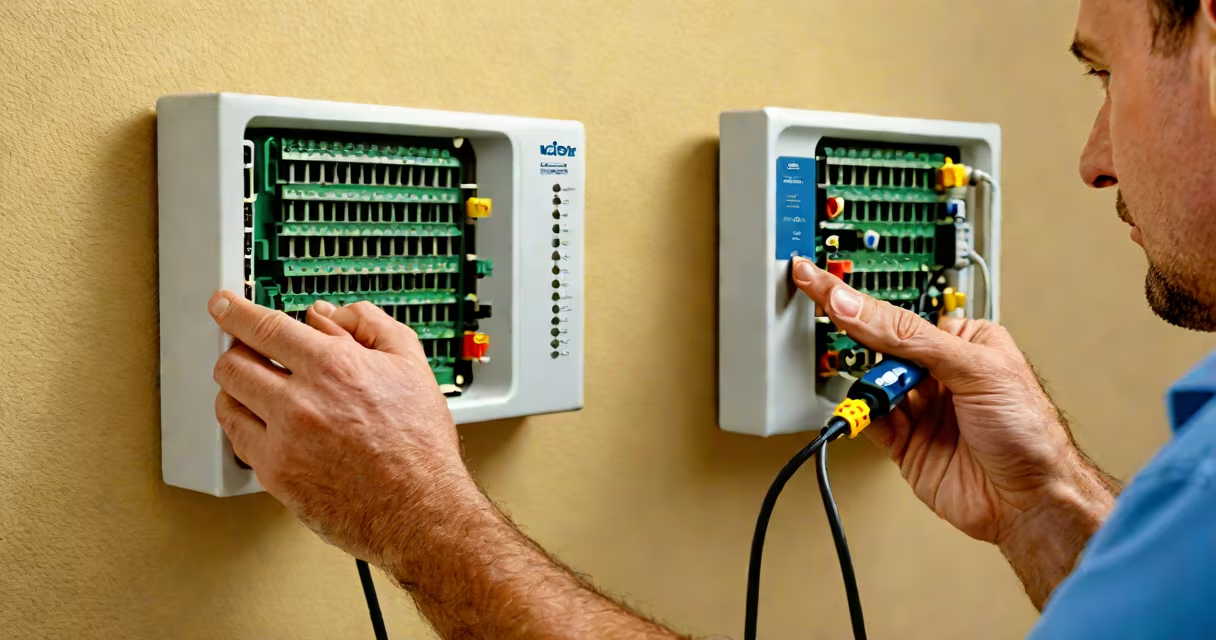
Digital Subscriber Line (DSL) is a family of technologies that provide high-speed internet access over standard copper telephone lines, using frequencies above those used for voice calls. It enables faster data transmission than traditional dial-up, making it suitable for web browsing, streaming, and online gaming.
DSL operates by splitting the bandwidth of a single copper wire into separate channels-one for voice and one for data. This allows simultaneous phone calls and internet use without interference. Unlike coaxial cable or fiber, DSL relies on existing telephone infrastructure, which limits its reach and speed compared to newer options.
According to the Federal Communications Commission (FCC), DSL remains one of the most widely deployed broadband methods in the U.S., especially in rural areas where fiber rollout is limited. The FCC reports that as of 2023, approximately 22 million U.S. households still rely on DSL for primary internet service.
DSL sends data through the same copper wires used for landline telephones. A device called a DSL modem connects to the telephone line and converts digital signals from the internet provider into usable data for computers and routers.
The signal travels from the provider's central office through local loops-copper cables running from the provider's hub to homes. Signal strength degrades with distance, so performance drops beyond 18,000 feet (about 5.5 km) from the central office. This is why DSL speeds vary widely based on location.
A common misconception is that DSL requires a dedicated phone line. While it's possible to run DSL on a line used for voice, many users install filters to isolate voice traffic from data traffic. Without filters, users may hear noise during calls or experience reduced internet speed.
Several variants of DSL exist, each differing in speed, distance limitations, and deployment requirements. The most common types are:
| Type | Max Speed | Distance Limit | Use Case |
|---|---|---|---|
| ADSL (Asymmetric DSL) | Up to 8 Mbps download | 18,000 ft (5.5 km) | Home internet, basic streaming |
| SDSL (Symmetric DSL) | Up to 2.3 Mbps both ways | 10,000 ft (3 km) | Small business, video conferencing |
| VDSL (Very-high-bitrate DSL) | Up to 100 Mbps download | 4,500 ft (1.4 km) | Urban areas, fiber-to-the-node setups |
ADSL is the most widespread form, used in over 60% of DSL deployments. It prioritizes download speed, ideal for consumers who stream videos or browse the web. SDSL offers equal upload and download speeds, better suited for businesses sending large files.
VDSL delivers much higher speeds but only over short distances. In cities, providers often deploy VDSL via "fiber-to-the-node" systems-where fiber runs to a street cabinet, and copper completes the last leg to homes. This hybrid setup improves performance while minimizing infrastructure cost.
One non-obvious fact: DSL performance depends heavily on line quality. A single damaged splice or corroded connector can reduce speeds by 50% or more. During installation, technicians often test line attenuation and crosstalk to predict actual throughput.
DSL remains in use primarily in suburban and rural regions where fiber-optic expansion is slow or economically unfeasible. In these areas, DSL provides a cost-effective alternative to satellite or mobile broadband.
For example, in parts of Montana and rural Texas, DSL is the only viable option for residents without access to cable or fiber. Providers like CenturyLink and AT&T continue to offer DSL plans at $30-$50/month, with speeds ranging from 10 to 50 Mbps.
Businesses in small towns also use DSL for backup connectivity. A café in rural Oregon, for instance, maintains a DSL line as a failover when its primary fiber connection goes down. This ensures uninterrupted operations during outages.
Despite its limitations, DSL is still preferred in some cases due to reliability. A 2022 study by the National Telecommunications and Information Administration (NTIA) found that DSL had a 94% uptime rate in rural markets-higher than mobile broadband in remote zones.
Many people confuse DSL with dial-up internet. Dial-up uses the same frequency band as voice calls and blocks the phone line during use. DSL operates on higher frequencies, allowing concurrent voice and data use.
Another frequent error is assuming all DSL is slow. While older ADSL lines max out around 8 Mbps, modern VDSL can exceed 100 Mbps. However, this speed is only achievable within 1,500 meters of the node. Beyond that, performance drops sharply.
Some users believe DSL requires a special phone jack. In reality, it works on standard RJ-11 jacks. But proper filtering is essential. I once installed a DSL line for a client who experienced constant disconnections until we added a microfilter between the phone and modem. After that, stability improved dramatically.
DSL is not the same as broadband. Broadband is a category that includes DSL, cable, fiber, and satellite. DSL is one type of broadband connection, not synonymous with it.
While DSL is being phased out in favor of fiber in urban centers, it remains relevant. According to the FCC's 2023 Broadband Deployment Report, nearly 13 million U.S. homes still receive internet service via DSL. Many of these users are in low-income or geographically isolated communities.
Providers are upgrading legacy networks with VDSL and vectoring technology, which reduces crosstalk and boosts speeds. AT&T's "Digital Life" program, for example, uses vectoring to deliver up to 30 Mbps downstream to customers within 3,000 feet of the node.
Still, DSL faces competition from wireless solutions. Fixed wireless access (FWA) powered by 5G is expanding rapidly in rural areas. In 2023, Verizon reported 2.1 million FWA subscribers-many replacing DSL connections.
For users still relying on DSL, understanding the difference between line speed and actual throughput is critical. A 25 Mbps plan may deliver only 18 Mbps in practice due to overhead and network congestion. Testing with tools like speedtest.net helps identify real-world performance.
Digital Subscriber Line continues to serve millions worldwide. Though slower and less reliable than fiber, it remains a practical solution where alternatives are unavailable. What does DSL do? It turns old phone lines into modern internet pipes-simple, affordable, and still widely used.