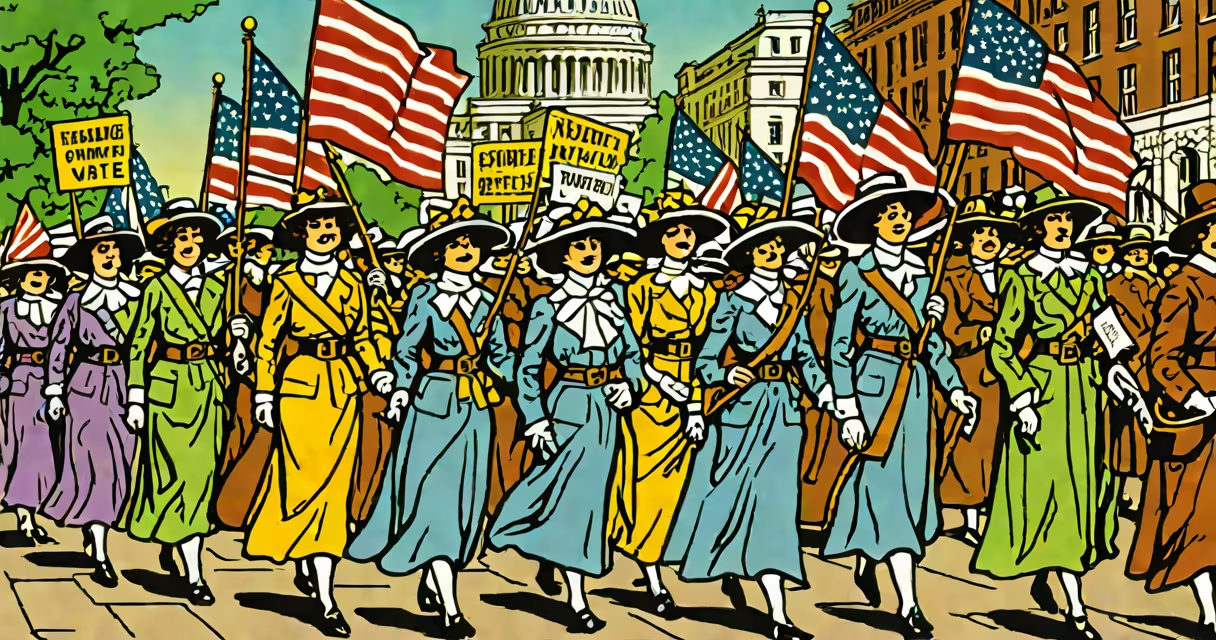
The cause of the 19th Amendment was the sustained, nationwide campaign by women's rights activists demanding the right to vote, driven by decades of protest, legal challenges, and grassroots organizing that culminated in its ratification in 1920.
The 19th Amendment to the U.S. Constitution prohibited any American state or the federal government from denying the right to vote based on sex. Its passage was not sudden-it emerged from a movement that began in the mid-19th century, long before the formal proposal in Congress.
At its core, the cause of the 19th Amendment was political exclusion. Women in the United States were denied the right to vote despite being citizens, property owners, and contributors to society. This inequality fueled organized resistance, particularly after the Seneca Falls Convention of 1848, where Elizabeth Cady Stanton and Lucretia Mott issued the Declaration of Sentiments calling for women's suffrage.
Women's suffrage efforts evolved from local advocacy into a national network. Early leaders like Susan B. Anthony and Alice Paul pushed for change through petitions, public speeches, and lobbying. By the 1890s, state-by-state campaigns had secured voting rights in western states such as Wyoming (1869), Colorado (1893), and Utah (1896).
These state victories demonstrated that women could vote without disrupting social order. They served as proof of concept. When states like Kansas and California granted limited suffrage in the early 1900s, the momentum grew. National organizations such as the National American Woman Suffrage Association (NAWSA) coordinated efforts across regions, while the more radical National Woman's Party (NWP) used civil disobedience tactics, including hunger strikes and picketing the White House.
In 1913, the NWP staged a massive parade in Washington, D.C., drawing thousands. Police failed to control the crowd, and many marchers were assaulted. The incident received widespread media coverage and exposed the risks women faced in seeking political inclusion. This event marked a turning point in visibility and public sympathy.
Several interconnected forces accelerated the amendment's passage. World War I played a significant role. As men left for combat, women took on industrial and clerical roles in new numbers. Their contributions to war production and wartime service were widely documented. The argument that women who supported the nation in crisis deserved equal civic rights gained traction.
President Woodrow Wilson initially opposed the amendment. But by 1918, he reversed his position, citing women's wartime labor and moral leadership. His endorsement was critical. In June 1919, Congress passed the amendment with bipartisan support, sending it to the states for ratification.
Ratification required approval by three-fourths of the states-36 out of 48. Tennessee became the key state. On August 18, 1920, the Tennessee legislature narrowly approved the amendment by a single vote-Governor Albert H. Roberts signed it into law the next day. The final certification came on August 26, 1920, when Secretary of State Bainbridge Colby declared the amendment part of the Constitution.
Many assume the 19th Amendment granted women the vote overnight. That is incorrect. The amendment did not create voting rights-it protected them. In 1920, 15 million women registered to vote, but many still faced barriers due to literacy tests, poll taxes, and racial discrimination. Black women in the South were often blocked from voting despite the amendment.
Another misconception is that the movement was unified. It was not. Divisions existed between white middle-class activists and Black suffragists like Ida B. Wells, who criticized the movement for sidelining race issues. The National Association of Colored Women (NACW) fought both for suffrage and against lynching, highlighting that gender and racial justice were intertwined.
A lesser-known fact: the 19th Amendment was not the first attempt. A similar amendment was introduced in Congress as early as 1868. It failed then and again in 1878. The 1919 version succeeded only after years of strategic recalibration-focusing on state-level wins before pushing for federal action.
Tennessee's ratification was decisive. The state legislature debated the amendment in August 1920. The vote was tied at 48-48. Representative Harry T. Burn, a young lawmaker from a rural district, initially opposed the amendment. But after receiving a letter from his mother urging him to "vote for ratification," he switched his vote.
His decision broke the tie. The state's governor certified the ratification. Without Tennessee, the amendment would have failed. This moment illustrates how individual actions within a larger movement can alter history.
Even after ratification, enforcement remained uneven. In 1924, the Supreme Court ruled in *Leser v. Garnett* that the 19th Amendment was valid and enforceable. The decision affirmed that Congress had authority under the Fourteenth Amendment to extend voting rights to women.
The causes behind constitutional amendments differ. While the 13th Amendment abolished slavery due to the Civil War and the Emancipation Proclamation, the 19th Amendment arose from a prolonged social movement rather than a national emergency. The 13th Amendment was enacted through military and legislative action; the 19th was achieved through sustained civil engagement.
| Amendment | Primary Cause | Timeline | Key Mechanism |
|---|---|---|---|
| 13th | Civil War, emancipation policy | 1865 | Executive order + congressional passage |
| 19th | Women's suffrage movement, state campaigns | 1920 | Grassroots activism, state ratification |
Understanding the difference highlights that constitutional change can emerge from conflict or from persistent civic effort. The 19th Amendment stands as a landmark of democratic reform through nonviolent mobilization.
The cause of the 19th Amendment was not a single event but a convergence of moral urgency, strategic planning, and mass participation. It remains a model of how sustained civic action can reshape a nation's foundational laws.