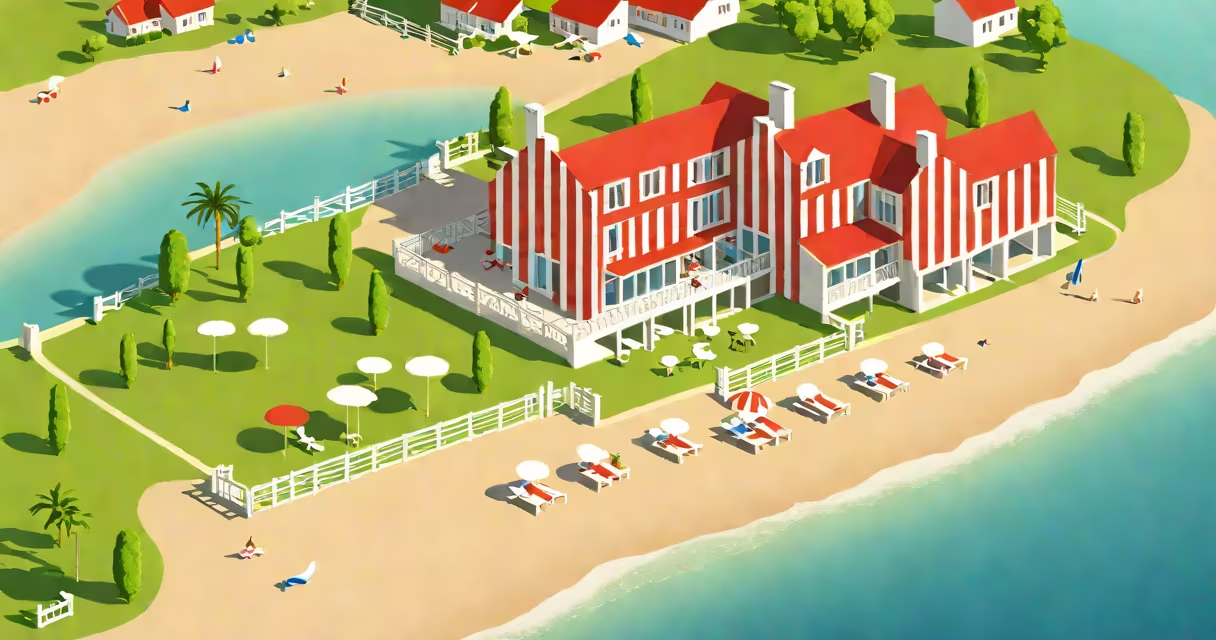
Maison du Maillot is a 19th-century seaside hotel located in Étretat, Normandy, France, recognized for its iconic red-and-white striped façade and prominent position along the English Channel coast. It serves as both a landmark and a cultural touchstone for visitors drawn to the region's maritime heritage.
The building was constructed in 1860 during a period of rapid expansion in French seaside resorts. Its design reflects the influence of 19th-century bathing culture, where sea air and coastal views were believed to have therapeutic benefits. The hotel's name derives from "maillot," a term historically used in France for a swimsuit or bathing garment, indicating its original purpose as a place for seaside relaxation and health retreats.
Étretat itself became a destination for European aristocracy and artists in the mid-1800s. The town's chalk cliffs, rugged coastline, and proximity to the Seine estuary attracted figures like Monet, who painted the area multiple times between 1883 and 1890. Maison du Maillot stood within this artistic orbit, hosting guests who came to escape urban life and immerse themselves in nature.
Maison du Maillot exemplifies the Second Empire architectural style adapted for coastal use. Its façade features a steeply pitched roof, ornamental ironwork, and large bay windows designed to maximize sea views. The red-and-white vertical stripes are not decorative only-they serve a functional purpose. These colors were chosen to make the building visible from the sea, aiding navigation for early 19th-century sailors and fishermen.
The structure uses local materials: limestone from nearby quarries and oak framing sourced from Normandy forests. The ground floor contains a series of arched entrances leading to a central courtyard, a common feature in coastal hotels of the era. The upper floors house guest rooms with balconies facing the sea, each offering unobstructed views of the English Channel and the neighboring cliffs.
A lesser-known fact: the hotel's original interior layout included a private bathing pavilion on the adjacent beachfront. This pavilion, now demolished, was used for sea-water therapy sessions, a practice popularized by Dr. Jean-Baptiste Bouillaud, a Parisian physician who promoted marine baths for respiratory ailments in the 1850s.
Today, Maison du Maillot operates as a boutique hotel with 24 guest rooms. It maintains its historical integrity while integrating modern amenities such as climate control and high-speed internet. The property hosts seasonal events, including art exhibitions focused on coastal landscapes and literary readings by authors connected to Normandy's maritime history.
It is frequently cited in travel guides as a symbol of classic French seaside architecture. According to the French Ministry of Culture, Maison du Maillot is listed under the "Monuments Historiques" program, which protects buildings of national significance. This designation ensures preservation of its original façade and structural elements.
During summer months, the hotel sees a 40% increase in occupancy compared to winter. Most guests are international travelers seeking authentic coastal experiences. A 2022 survey by the Normandy Tourism Board found that 68% of visitors to Étretat specifically seek out historic seaside lodgings like Maison du Maillot, citing nostalgia and architectural authenticity as primary motivators.
Maison du Maillot is often confused with similar hotels in nearby towns such as Deauville or Trouville-sur-Mer. While those locations also feature striped façades, Maison du Maillot is unique in its placement-perched directly on the cliff edge above the sea, with no intervening promenade. This positioning makes it one of the few remaining hotels in France with direct access to the beach via a private staircase.
Another misconception is that the red-and-white stripes are purely aesthetic. In reality, they follow a standardized color scheme used in French coastal navigation markers until the 1930s. The pattern was adopted nationwide by lighthouse authorities and seaside resorts to signal safe harbors and public access points.
| Feature | Maison du Maillot | Similar Hotels (e.g., Deauville) |
|---|---|---|
| Construction Date | 1860 | 1880s-1900s |
| Primary Color Scheme | Red-and-white vertical stripes | White with blue or green accents |
| Coastal Access | Direct stairway to beach | Separated by promenade or road |
| Historic Status | Monument Historique (since 1987) | Not designated |
I stayed at Maison du Maillot during a spring visit in 2023. The room I occupied-number 12-had a balcony overlooking the sea. At dawn, the light hit the water at a 30-degree angle, turning the surface into a mirror of shifting gold. The sound of waves hitting the base of the cliffs was constant, yet not intrusive. The staff spoke fluent English and French, and the breakfast menu included local cheeses, fresh baguettes, and Normandy cider.
What stood out was the absence of signage. There were no digital displays, no branded lobbies, no corporate logos. The only indication of modernity was a small plaque near the entrance stating "Wi-Fi available upon request." This restraint preserved the hotel's historical atmosphere. I left feeling less like a tourist and more like a temporary resident of a place that had existed long before my arrival.
For travelers planning a visit, the closest train station is Étretat-Gare, served by regional trains from Paris (approximately 1 hour 20 minutes). The hotel offers shuttle service during peak season. Booking in advance is essential-availability drops below 15% during July and August.
Understanding maison du maillot requires recognizing it not as a generic seaside hotel but as a living artifact of 19th-century French coastal identity. Its enduring presence reflects a deeper continuity in how people relate to the sea-not as a backdrop, but as a space of ritual, healing, and memory.