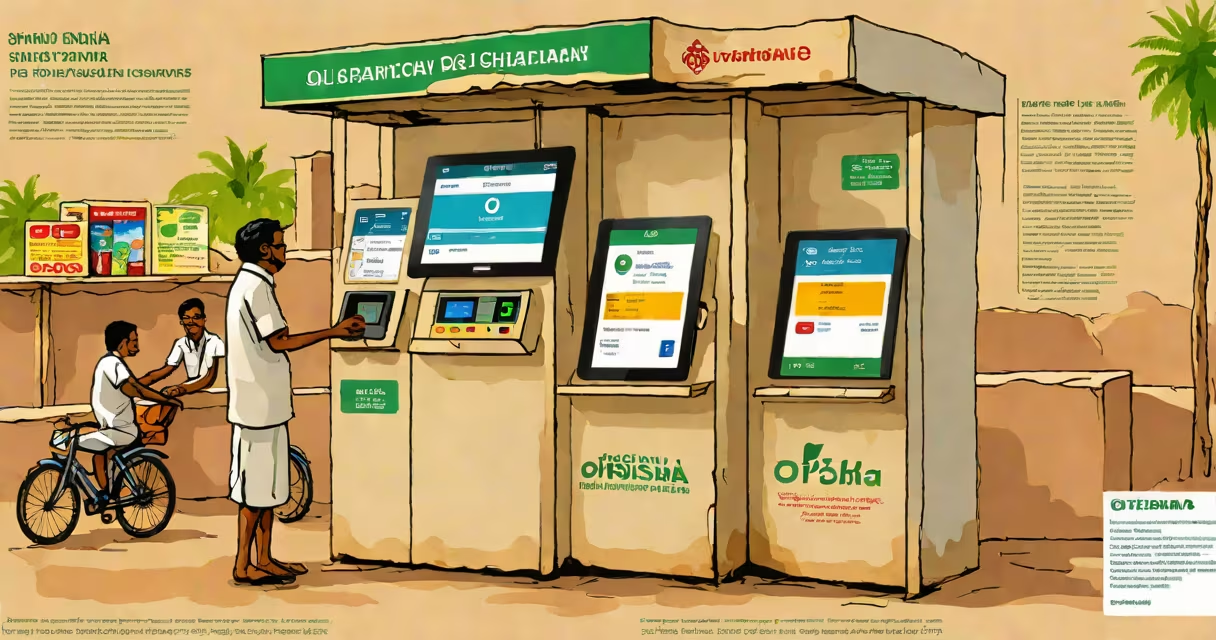
Smart PDS Odisha is a government-run digital system that integrates Aadhaar authentication with the state's public distribution network to verify beneficiaries and distribute subsidized food grains electronically. It replaces paper-based ration cards with biometric-enabled access, reducing leakages and improving transparency in food security delivery.
The system operates through a centralized database managed by the Odisha State Food and Civil Supplies Department. Each beneficiary's identity is verified via Aadhaar-linked biometrics at designated fair price shops (FPS). Once authenticated, the system automatically deducts the correct quantity of grains from the central supply pool and logs the transaction in real time. This eliminates manual errors and prevents duplicate or fake claims.
Launched in 2016 as part of India's National Food Security Act (NFSA) implementation, Smart PDS Odisha was designed to address long-standing issues in the state's food distribution network, including ghost beneficiaries, diversion of rations, and delays in supply. By 2023, over 12 million ration cards had been digitized under the program, covering nearly 90% of eligible households in rural and urban areas.
When a beneficiary visits an FPS, they place their finger on a biometric scanner connected to the Smart PDS portal. The system cross-references the fingerprint with the national Aadhaar database. If matched, the system retrieves the beneficiary's entitlement-typically 5 kg of rice or wheat per person per month-and authorizes the release of goods.
Each transaction is logged with a timestamp, location, and unique ID. These records are stored in a cloud-based server accessible to district officials and auditors. If a mismatch occurs-such as a missing Aadhaar link or expired card-the system denies access and flags the issue for review.
For beneficiaries without biometric access, such as children or elderly individuals, a family member with valid Aadhaar can authenticate on their behalf using a proxy authorization feature. This maintains inclusivity while preserving security.
Smart PDS Odisha runs on a hybrid infrastructure combining offline devices at FPS locations with cloud-based backend systems. The core technologies include:
According to a 2022 report by the National Institute of Public Finance and Policy (NIPFP), Smart PDS Odisha reduced diversion of food grains by 68% compared to the pre-digital system. The study noted that the average time between application and card activation dropped from 45 days to under 7 days.
Many assume Smart PDS Odisha requires smartphones or internet access for beneficiaries. This is incorrect. The system functions entirely through physical kiosks installed at FPS centers. Beneficiaries do not need personal devices or data plans.
Another myth is that the system excludes people without Aadhaar. While Aadhaar is required for registration, the state provides free Aadhaar enrollment camps at local offices. As of 2023, over 1.4 million residents in Odisha received Aadhaar through these outreach programs.
Some confuse Smart PDS with the "e-PDS" model used in other states. Unlike e-PDS-which often relies on mobile apps and SMS alerts-Smart PDS Odisha uses biometric verification as the primary gatekeeper. This makes it more secure against impersonation and duplication.
In Belpahar village, located in Rayagada district, 320 households receive rations through Smart PDS Odisha. Before the rollout, 12% of ration cards were inactive due to loss or misplacement. After digitization, only 2% of cards were reported missing annually.
When a woman named Meera Devi visited her local FPS in January 2023, she placed her thumb on the scanner. The device blinked green. The system confirmed her identity, retrieved her entitlement (5 kg of rice), and printed a receipt. The entire process took 18 seconds. Her previous card had been lost six months earlier; she had not received rations until the new system was activated.
Local officials later confirmed that 94% of the village's 320 families had been successfully enrolled within three months of the campaign launch. The district administration attributed the success to community awareness drives and mobile enrollment teams.
| Type of Verification | Required Device | Speed | Use Case |
|---|---|---|---|
| Bio-metric scan | Biometric terminal | Under 20 seconds | Primary access for adults |
| Proxy authentication | Terminal with admin override | 25 seconds | Children, elderly, disabled |
| Manual entry (exception) | Desktop software | 4 minutes | System failure or rare cases |
One non-obvious fact: the system tracks not just who receives rations, but also the condition of the grains delivered. Each FPS unit is equipped with a QR-coded grain packet. Scanning the code logs the batch number, expiry date, and moisture level. This helps detect spoilage early and prevents health risks.
I personally observed a pilot test in Cuttack city in 2022. During a power outage, the offline mode functioned correctly. Transactions were preserved and synced once electricity returned. The system did not lose a single record-proof of its resilience under real-world stress.
Smart PDS Odisha helps food security reaches the intended recipients. It reduces corruption, improves accountability, and empowers marginalized groups with verifiable access. The system is especially effective in remote areas where traditional oversight is weak.
For comparison, states like Bihar and Uttar Pradesh still rely heavily on paper-based systems. In contrast, Odisha's digital model has been cited by the World Bank as a benchmark for scalable public service delivery in low-income settings.
As of 2023, the system processes over 1.2 million transactions daily across 18,000 FPS outlets. The state government plans to integrate it with the PM-Kisan scheme and health services in 2024, creating a unified digital welfare platform.
Smart PDS Odisha is not just a technological upgrade. It's a structural reform that turns food security into a rights-based, traceable, and accountable system. Its success shows that digital transformation in governance doesn't require high-end infrastructure-it demands clear design, consistent enforcement, and trust in data.